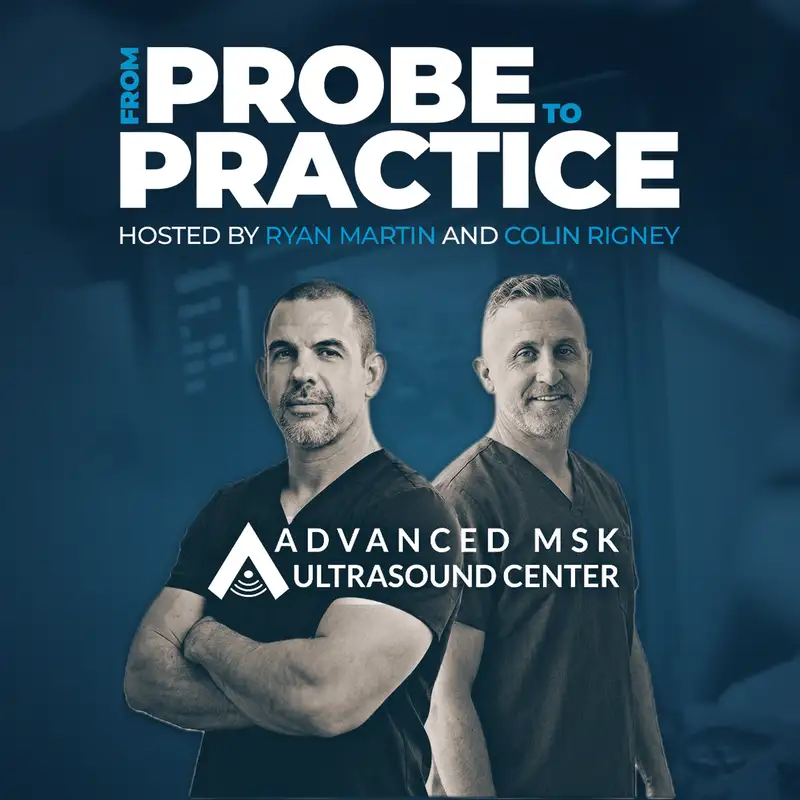
[0:00] Narrator: This week on From Probe to Practice.
[0:03] Colin Rigney: I think that AI is going to make smart people smarter. The smart people are going to get smarter with it, and the dumb people are going to get dumber, right?
[0:14] Narrator: An Advanced MSK Ultrasound Center podcast, From Probe to Practice, hosted by Ryan Martin and Colin Rigney, produced by Jason Kitza at NGG, NeedGreaters.com.
[0:32] Ryan Martin: Welcome back to Probe to Practice. I'm here, Ryan Martin. I'm here with Colin Rigney. How you doing?
[0:38] Colin Rigney: I'm doing great, man.
[0:39] Ryan Martin: And we have so much to keep talking about. It's like the bucket is so deep for the topics that we can talk about. And today is no different. Today might, I would say, today might really irk some people. It might spark some controversies. It might spark a little bit of heated debate in there. I'm not going to give away what it is quite yet. We talked a lot about operator dependency, you know, understanding that there was a lot of pushback to people doing ultrasound because of operator dependency. Let's start with that real quick. Let's just do a quick recap. What are your thoughts about operator dependency?
[1:17] Colin Rigney: Well, the big takeaway we levered last time was it's not operator dependency as much as it's system dependence. independence, what kind of system did you train in? And by default, that's the operator, right? And so there's a lot of variability between operators and ultrasound. And that variability is really a reflection of what kind of system you trained in, right? And what was the quality of it? What was the detail of it? And we dug pretty deep into that. So going into, why don't you go ahead lead into what we're going to talk about today because I think it segues nicely
[1:59] Ryan Martin: Well it's interesting okay so operator dependent right let's put the term operator as human right and so humans are doing ultrasounds currently right you're a human I'm a human most people we teach I think they're pretty much human but here's the here's the thing is more and more often we're hearing the term AI and what are people saying they're saying oh AI is going to take our jobs and it's gonna run the world and here comes skynet and everything like that but the truth is AI is everywhere and it's found in different realms and it's no different for MSK or ultrasound in general I mean AI has been in radiology before it was you know really but let's go to that real quick and let's talk about a few points about the AI And let's talk MSK Ultrasound specifically. Now, Colin, is there currently any AI in MSK Ultrasound?
[3:00] Colin Rigney: You're starting to see it now. There's a few companies out there that are putting it in their products and giving a slice of the anatomy and they'll color the anatomy when you put the probe on the skin. You know, it's not without its flaws. And I think that it's in the beginning stages of something that could be really useful. But right now, you know, it's really in the kind of fledgling state. I think it's going to happen pretty quick over the next few years. So let's get into a little bit of, you know, what we see in the human side that's got to drive that innovation. Well,
[3:40] Ryan Martin: Okay, let's backpedal just a smidge here. Let's kind of explain our history on AI and MSK Ultrasound. So Colin and I have an interesting little backstory to the AI. So it's not like we're just looking up Google and saying, hey, is AI going to take my job? We've actually worked with a company to help develop the human side. So the rigorous platform checking, reviews, and all the image acquisitions, we did that for a company for their AI. So I think we could just kind of briefly touch on that.
[4:15] Colin Rigney: That yeah so yeah what do we do man human
[4:19] Ryan Martin: Operators to help train large you know these language models on how to look at images so imagine looking at hundreds and hundreds of scans of the patellar tendon the achilles tendon the plantar fascia and tracing them out by hand and then measuring them by hand and saying normal or abnormal and feeding that to a system that can recognize it over time and color code it. And again, I think you were kind of leading to this point a little bit before is over time, these algorithms will understand how to recognize tissue and patterns and what's norm and what's abnormal for the most part.
[5:04] Colin Rigney: But I think
[5:05] Ryan Martin: The biggest flaw right now is
[5:07] Colin Rigney: There's
[5:09] Ryan Martin: Variability in imaging, right? And it's based off statistical analysis, right? So for every 10 plantar fascias that you see over 4.5 millimeters, there's going to be one that's 4.2 and it's going to miss the diagnosis or whatever, you know, because not everything's perfect, right? But statistically, those are how the algorithms go. So back to what I was saying is you and I worked really hard for a long time on AI algorithms for a company and we've seen how it's grown. And now it seems like almost every company is trying to jump on the bandwagon. But my question to you, Colin, is should we get hyped on the platforms that are having AI embedded in them right now?
[5:59] Colin Rigney: No, I always look at all this stuff with a measure of caution. Let's keep in mind that AI has been around a long time, longer than it's been when certainly in the mainstream vernacular, you know, Google was AI, right? Let's not forget that. And all they did was just make it open, you know, a handful of years ago and all of a sudden, oh my gosh, right? So, you know, and going back to the internet age, right? How was the fuss around that with respect to, oh my gosh, it's going to change jobs. It's the fear factor around Okay, so let's just dial it back some. I think that AI is going to make smart people smarter. The smart people are going to get smarter with it, and the dumb people are going to get dumber, right? And I like to stay above the fray with the overgeneralization of how to approach this. I think when used the right way, it's going to have a massive effect. It can have a massive effect. But with respect to AI and ultrasound specifically, it still comes down. It's all the acquisition of images, and I'm still doing some projects right now for a couple groups, is 100 % comes down to the human input. And it's going to be evergreen in terms of needing that. I don't see, at least in the next decade or more, it not being dependent on human input. And I think we'll get into this. We were talking about this before we came on. You still have to have the base foundation knowledge of sonoanatomy in order to properly interpret what the AI is going to tell you.
[7:56] Ryan Martin: Right okay if you didn't know what the the anatomy are you what's the point right no I understood absolutely
[8:02] Colin Rigney: Or if it's feeding you some pathology like how are you just going to trust it or are you can you critically like you mentioned okay this thing is like four millimeters over whatever standard is right and like okay can you differentiate an incidental finding versus is not right and those are the things that's the nuance where and let's not also forget there's a there's a book I read recently by adam grand is called oh my
[8:36] Ryan Martin: Gosh I'll
[8:40] Colin Rigney: Think of it here in a second it's sitting right behind me but the thing was around AI and in the future and what's going to be at a premium in the future and we're already there is the human The human element, the character, the character development. And this is what patients are still going, that the market is going to demand this with respect to healthcare clinicians and doctors in doing things at the point of care. Now, there's some things they can be super helpful with that can be automated for sure. However, when it comes to minimally invasive or invasive procedures and having those discussions, you know, the society is going to still dictate the market when it comes down to how they want that care delivered. And to have every decision made by AI leading up to something like that, that's potentially life altering, is going to require a course of care and aftercare and all those things. The human element is 100 % going to need to drive that process. Can we make it more efficient with AI? Absolutely. I see a lot of promise, and specifically, you know, I teach it in A.T. Still University in the, like, residential programs, and I see a ton of potential for these AI sono -anatomy programs to teach base -level anatomy. And I think when done under supervision in a good, like, structured program for the novice, I think it has immense potential but is there is it you know that that's just where we're at right now I'm not going to see or predict where it's going to go in you know x number of years but again I just look at everything with a measure of caution with this I don't get over hyped I don't I don't go too crazy with it and I also I also never say never because honestly we don't know right and so
[10:39] Ryan Martin: We don't know what happens in the next five years we don't even know what's going to happen this year. With the exponential growth of technology that it is now, we don't even know what's going to happen in six months, right? A new development can happen at any point in time. So yes, I agree with you. Now question, we will put Adam Grant's book in the notes. Is it Think Again or Hidden Potential? Hidden
[11:01] Colin Rigney: Potential.
[11:02] Ryan Martin: Yeah. Okay. So we'll put in the notes, Adam Grant's Hidden Potential book. So if anybody has questions about that, you can, you can look that up and Adam Grant, you're welcome. Here's your plug. So, moving from that. So, I mean, I, and I would never say that we've exhausted the AI discussion. I think we're going to end up having more of these, but I think the point is here is yes, it's there. No, it's not going to take your job. Okay. It's going to help amplify your job. And I think it's going to help some of the training elements that you and I do to help kind of move our residents along a little faster. So I think there's an application to it. I think you're right 100%. There's going to be human dependency somewhere down the road, especially when it comes to somebody's life, right? Somebody's health, somebody's life. There should always be somebody in the background of that. So I don't want to jump topics like grand, like huge, but one of the topics that was brought up was dynamic evaluation on ultrasound which again if you want to talk about AI and dynamic assessment I think it's not there yet but
[12:13] Ryan Martin: Let's talk about dynamic or it didn't happen what does that mean
[12:20] Colin Rigney: Yeah so it's like you know you're talking to your buddies like oh I did this thing or I caught this fish I climbed the cliff right and you're just telling the story and it's like you know a guy called bullshit I need to see a picture or video or else it didn't happen right So, ultrasound is a, you want to use it to the highest capacity you can, and the advantage it has over other imaging tools is the ability to dynamically assess something. And so, that's our funny way of saying that, you know, if you didn't evaluate it dynamically, did you even use ultrasound? Like, did you even leverage it the way it's supposed to be used? And I think that's what we want to get into with
[12:58] Ryan Martin: This. yeah and it's funny is most of the case studies case reports that you see on social media during your doom scrolling sessions is their static images sometimes you have some dynamic you know images but you see all these static images and they say this is what I see this is what I see and at the end of the day did you like how big was the fish you caught right
[13:19] Colin Rigney: So yeah
[13:20] Ryan Martin: So no I think you're 100 right dynamic or didn't happen and when we teach this we teach algorithms for dynamics for pretty much everything there is. And
[13:32] Colin Rigney: The
[13:33] Ryan Martin: Beauty of teaching physical therapists, athletic trainers, sports med physicians, orthopedics, they understand the biomechanics of the human body, which helps a lot. Now I'm not knocking sonographers, but that's not in their wheelhouse, you know, right off the bat. Doesn't mean they're not going to be good at it, but that's not in the wheelhouse, you know, right off, you know, get go like off jump street. right and so I think one thing that has a leg up in the MSK industry is the PTs the athletic trainers is understanding the biomechanics and the patho mechanics of how things work how they shouldn't work the anatomy there and if you don't understand those things and you're just moving the body around what again dynamic is only as good as the user that knows what the mechanics are.
[14:18] Colin Rigney: Right.
[14:20] Ryan Martin: So, I mean, that's my little soapbox. I feel like this platform for probe to practice is kind of our little, our step stool to our soapbox. But is there anything in the dynamic
[14:34] Colin Rigney: World?
[14:35] Ryan Martin: What do you think would make it better? Do you think it's education based? Do you think it's having a biomechanics foundation? How do we get more practitioners to understand dynamic evaluations?
[14:48] Colin Rigney: I, I'm going to be a little bit more philosophical with it. I think that the ability to leverage dynamics to its full potential is only limited by your creativity. And by creativity, you have to, you have to like really break down the kinesiology of whatever structure you're evaluating, right? So you have to know what position is going to stress it what is an isometric contraction what's an isotonic contraction what is what is a rate what special tests right so there should be a base level knowledge of all those things with respect to what you're looking at if you have if you have a decent foundation there then you have everything it takes to use it use dynamics and ultrasound to as really as full potential now that so I think that was I think I was pretty clear with how you the background of how that how that how that works right and so what are what are some things that you see so with some of our doctors who and this is and I and I'll say this after you but like I know some gaps I've seen with certain you know let's just say specialties versus others right okay on gaps in you know if you if you get a doctor with a certain background and you're teaching the protocol and we're teaching our dynamics let's just say the shoulder and we're getting to a supraspinatus or the posterior glenohumeral joint or even the axillary part of the humeral glenohumeral joint whatever right and you give like some docs with a particular background like all you have to do is say like one or two words they get it right versus others you have to go into oh the mechanics of this here is why We teach it and go forward, you know, with a little more detail and explanation. So what are some gaps that you've seen when teaching doctors different dynamics with ultrasound?
[16:55] Ryan Martin: And again, I think it's previous history of education exposure for biomechanics, those kind of things. But the biggest gaps are when you're explaining the pathology itself and how does it react? What is it attached to? what happens to the scapula during this what happens and you know what are we looking for I think the biggest gap honestly and it's across the board I think the biggest gap is anatomy yeah you know because everybody knows surface level anatomy everybody's taking an course but the depth of knowledge that you need for MSK ultrasound for anatomy is unparalleled in fact level I taught anatomy physiology I ran a lab I ran a cadaver lab and I thought I knew anatomy inside and out. And ultrasound still humbles me to this day. So I think the biggest gap for doing dynamics is understanding what's playing a role, right? Is the anatomy under the mechanics? And then maybe the physics of the mechanics itself, like, is this a pulley system? Is it a lever? How is this supposed to contract? You know, what tissues coincide with this? What is, I mean, gosh, you could even go into like, you know, principles of when one muscle relaxes, the other contracts and vice versa, you know, like you could be so much. And the biggest gap is that's not taught in general education. Right. And it is imperative to have this skill set to be amazing at MSK. I think you can be good at MSK ultrasound without it, but you're never going to excel to be that amazing clinician. So now the big gap is the underlying anatomy and understand what it, what it's supposed to do.
[18:32] Colin Rigney: Yeah. And I, and I do think that doctors who have a specialty in orthopedics, sports medicine, physical therapists and athletic trainers typically pick up the dynamic piece better because of how, and like PM and R physicians because of their background in just rooted in assessing MSK systems, right. right, versus, you know, somebody from a pain management background and anesthesia pain background, they don't get the same rigorous training in physical exam special tests, right, as part of their fellowship and residency. And those are there. Much of that is for them is picked up, you know, in, you know, post postgraduate education and courses and just on a continuing education so you know there's a there's a lot to catch up for some specialties more than others and
[19:32] Ryan Martin: There is something to be said about people who have had a history in athletics people that understand how they're yeah but how the human body works I think there's something to be said about people that have used their body I'm not knocking couch potatoes okay well I am. But what I'm saying is, I think there's something to be said about people that understand their body mechanics that have used it in a way that's been athletic. So I think that's a little variable in it as well. But anyway, without getting too far into the weeds, dynamic or didn't happen, I think we need to keep addressing with social media, with our residents, with teaching is understand the dynamic nature. I mean, what separates ultrasound from CT scan, from MR, from x -ray? You know, what separates it from everything else? How do
[20:25] Colin Rigney: You chunk your needle, right? That's all dynamic.
[20:28] Ryan Martin: Exactly. And so at the end of the day, if you're not using dynamic capability as an ultrasound, you're just taking pictures. You're a photographer. And so at that point, don't try and diagnose.
[20:41] Colin Rigney: Absolutely. Okay. Yeah, you want to, you know, the big takeaway here is learn dynamics and might recall, you might be recalled to revisit some of your special tests and exams and go back to, as you said, anatomy, you know, tendon bone, what's attaching what and how do you stress what. what these are all the all the dynamic exams are rooted in is anatomy and special tests and I think that once those concepts are revisited and refreshed you know this becomes a lot more simple in terms of applying it right
[21:22] Ryan Martin: Right so Colin what do we have to look forward for the next episode a little sneak peek I know we're going to be talking about special tests which I think falls in line with dynamic you know dynamic scamming scanning but I think next episode we're going to be talking a little bit about special tests especially that orthopedic sports med physical therapy special test that we use the validity of them and do we still use them I think that's gonna be our next episode so I'm looking forward to it Colin as always I appreciate you being here and helping this whole you know you know ecosystem of education for everybody. This is all, this all goes to the evolution of education, to be honest, you know, and this is just one more avenue is for us to, well, also for us to rant, but this is one more avenue for, to, for teaching moments. I hope, I don't know.
[22:14] Colin Rigney: Yeah, absolutely. I think that, you know, you and I have been doing this a long time and this is just a form to get who we are and what we like to be passionate about out there. Right. Because Ultimately, it's not hard to find information anymore, but I think, you know, our footprint is to deliver it in a way that's fun, that's unique, that's practical, and, you know, hopefully help some people on the way with it.
[22:45] Ryan Martin: Absolutely and I think one thing to note before we cut to the you know cut to the end here is don't forget that even if you have questions about dynamic evaluations or if you have questions about biomechanics guess what it's on our website AMSKU.com you know all of our courses go over dynamic evaluations for every body region so I feel remiss if I didn't say that because that's important to note yeah
[23:12] Colin Rigney: Yeah specifically the live scanning videos we have and the protocols all have the dynamic elements in there as far as body position cueing and all those things yeah absolutely that's a that's a big part of our curriculum
[23:26] Ryan Martin: Cool man well hey thanks for joining you know I always appreciate these talks you know it's funny is you know we live in the same town, and the only time we ever see each other is either virtually here or on the road at conferences. So always good to see you, Colin.
[23:43] Colin Rigney: Yeah, absolutely. Well, if you didn't live halfway up to Flagstaff, we might see each other more often.
[23:49] Ryan Martin: Touché.
[23:51] Summit ad: 10 years ago, an ultrasound unit cost $20,000 or more. Now you can run one off your phone. So the question isn't whether you'll scan, it's what you'll do with it next. I'm Colin Rigney. I'm Ryan Martin. At AMSKU, we teach clinicians musculoskeletal ultrasound. On Saturday, December 5th, we're bringing the field together for the AMSKU Annual Global Summit. One day of MSK ultrasound and orthobiologics, fully online. No flights, no hotel, no closing your clinic. The whole day is built around four questions. Where does AI fit in ultrasound diagnosis? What's next in orthobiologics and regenerative medicine? Where does point -of -care ultrasound go from here? And what does the practice of the future look like? Dr. Don Buford, Dr. Scott A. Sigmund, Dr. Mark Pietropali, Dr. Ariana Demers, and many more. Three tracks, and every session has Q &A, so you can ask them yourself. Last year, clinicians joined us from five continents. Every session is recorded, so you keep it. The best moment in teaching is when the image clicks and you stop guessing. train your eye trust your hand tickets are at summit dot AMSK you duck the next decade starts in your hands AMSK you AGS 2026 last
[25:13] Somebody Tell Them: Last year we wrote four epic songs for the doctors who missed it this year we got a whole choir together to tell you beforehand trust us you don't want to miss it advanced musculoskeletal ultrasound centers annual global summit AGS 2026 The next decade starts in your hands.