"How do you know what abnormal is if you don't know what normal is?"
Every tissue has a signature. Bone is bright white. Tendon and ligament are fibrillar, like a guitar string. Nerve in short axis is a bundle of grapes, or a honeycomb. Muscle is sinuated and feathery. Fat is marbled. Learn those cold and pathology announces itself, because pathology is a departure from a picture you already hold.
Skip that step and the screen will hand you a diagnosis you invented. Tip the probe a few degrees and a normal tendon goes dark, and dark reads as pathology. As Ryan Martin puts it, you check the contralateral side, you do everything right, and really all it was was a difference in how you held the probe.
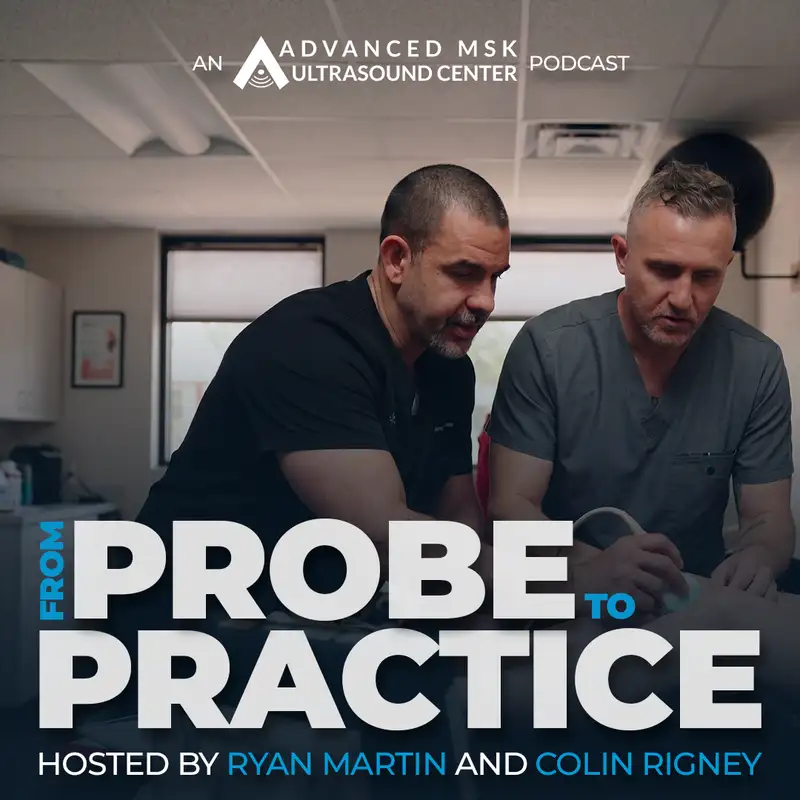
Colin Rigney and Ryan Martin spend this episode on reading echo texture and the pattern recognition underneath it. Also in this episode: how to tell nerve from tendon when they look identical in short axis (make the tendons glide and watch what stays still), how to separate a fat pad from the quad tendon by pushing on the skin, the three questions Colin asks at every tendon-bone interface, why a cortical change on the infraspinatus means something different from the same change on the supraspinatus, the little dip before the enthesis that will let you invent a tear at the critical zone, and why an isolated infraspinatus tear is rare enough to make you look again.
The Monday-morning takeaway: before you grade anything, ask whether you have seen enough normal of that exact tissue to know what you are looking at. If the answer is no, that is not a reading problem. That is a reps problem.
In this episode:
0:00 — Thirty scans a week, and why reps win
0:32 — Hosts, dogs, and a drive to Tempe
2:02 — Welcome to episode four
3:59 — Today's topic: reading echo texture
4:41 — Start with the machine, not the anatomy
4:59 — Echogenicity, and 256 shades of gray
5:37 — What each tissue should look like
6:11 — Know normal, then judge the departure from it
7:20 — Echo texture can lie to you
8:06 — Anisotropy: the same tendon, two pictures
9:01 — Telling nerve from tendon in short axis
9:58 — Tendons glide, nerves stay still
10:48 — Fat pad or quad tendon? Push on the skin
11:55 — Grading the departure from normal
12:50 — Why we start with the shoulder
13:24 — Three questions at the tendon-bone interface
14:15 — Not all cortical changes are equal
16:04 — Fooling yourself at the critical zone
16:38 — Rarely an isolated infraspinatus tear
17:46 — In clinic, the first thing you see is abnormal
18:33 — The limiting factor is how many scans you do
19:53 — Tendinopathy or tear: what to look for
21:47 — Google will not teach you this
23:18 — Reading echo texture is the foundation
25:47 — Thirty scans this week
27:29 — Where to start if you are new
29:01 — Course links and sign-off
0:00 — Thirty scans a week, and why reps win
0:32 — Hosts, dogs, and a drive to Tempe
2:02 — Welcome to episode four
3:59 — Today's topic: reading echo texture
4:41 — Start with the machine, not the anatomy
4:59 — Echogenicity, and 256 shades of gray
5:37 — What each tissue should look like
6:11 — Know normal, then judge the departure from it
7:20 — Echo texture can lie to you
8:06 — Anisotropy: the same tendon, two pictures
9:01 — Telling nerve from tendon in short axis
9:58 — Tendons glide, nerves stay still
10:48 — Fat pad or quad tendon? Push on the skin
11:55 — Grading the departure from normal
12:50 — Why we start with the shoulder
13:24 — Three questions at the tendon-bone interface
14:15 — Not all cortical changes are equal
16:04 — Fooling yourself at the critical zone
16:38 — Rarely an isolated infraspinatus tear
17:46 — In clinic, the first thing you see is abnormal
18:33 — The limiting factor is how many scans you do
19:53 — Tendinopathy or tear: what to look for
21:47 — Google will not teach you this
23:18 — Reading echo texture is the foundation
25:47 — Thirty scans this week
27:29 — Where to start if you are new
29:01 — Course links and sign-off
Mentioned in this episode:
MSK Ultrasound Evaluation of Rotator Cuff Tear vs Tendinopathy — Ryan's case-study course on grading tendinopathy and telling it from a tear. 1.0 AMA PRA Category 1 Credit: https://www.amsku.com/courses/musculoskeletal-ultrasound-evaluation-of-rotator-cuff-tear-vs-tendinopathy-with-case-studies/
Introduction to Musculoskeletal Ultrasound — the physics, machine optimization and normal sonoanatomy course Ryan points to when he says start with normal: https://www.amsku.com/courses/introduction-to-musculoskeletal-ultrasound/
Free shoulder e-book, if you want somewhere to start at no cost: https://zfrmz.com/RwwBmQJTGwgnyUJItYdy
Introduction to Musculoskeletal Ultrasound — the physics, machine optimization and normal sonoanatomy course Ryan points to when he says start with normal: https://www.amsku.com/courses/introduction-to-musculoskeletal-ultrasound/
Free shoulder e-book, if you want somewhere to start at no cost: https://zfrmz.com/RwwBmQJTGwgnyUJItYdy
New episodes every Tuesday.
From Probe to Practice is brought to you by the Advanced MSK Ultrasound Center — courses, residency and live workshops: https://amsku.com