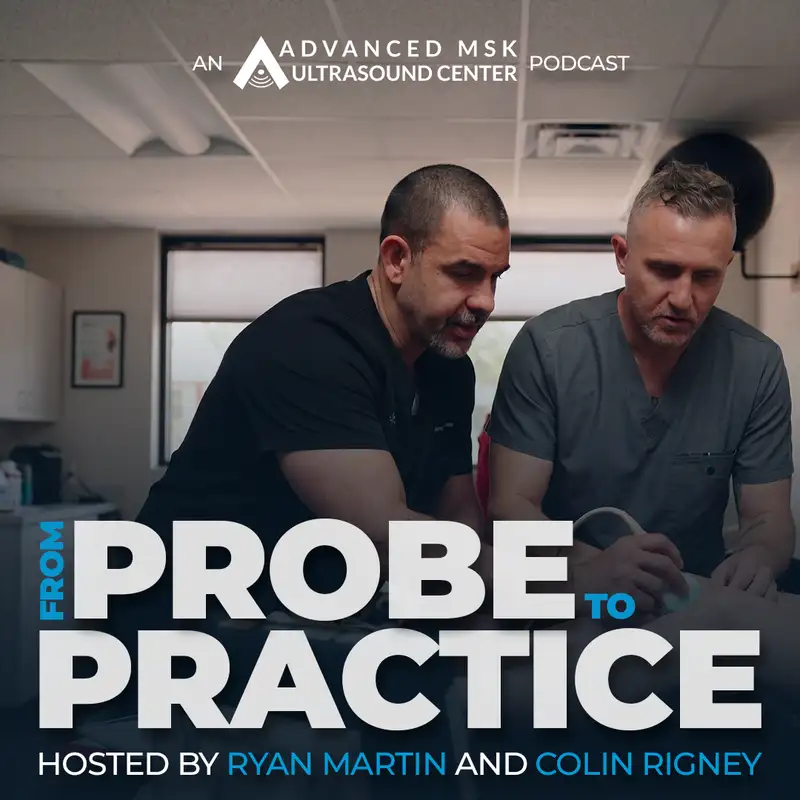
This week on From Probe to Practice. This is probably going to be harder than you think it's going to be and you have to be okay with that. Oh, the first 25 scans is like, what the hell am I looking at phase? Like you really don't know. You're just doing it because you're looking at the book, you're looking at the videos, then you're trying to do it and you're trying to get the picture.
and then we tested it dynamically and we looked at it and we're like oh shoot that's not a Baker's cyst you know good thing that we didn't try and you know um drain that An Advanced MSK Ultrasound Center podcast, From Probe to Practice. Hosted by Ryan Martin and Colin Rigney Produced by Jason Kitza at NGG needgreaters.com all right three two one all right welcome everyone how are things he's doing man oh they're good so i mean i think the last couple episodes i was driving and this is one time that i actually get to sit down i'm not in a clinical setting i'm actually in my guest house right now so it might have like a little bit of a vault so it might have a little echo to it so uh we have a great you know digital guy behind us you know that's taking care of this Jason Kitza uh he's gonna make sure that it doesn't sound like i'm in a an echo chamber well it sounds good on my end okay so what are we gonna talk about today we're starting to get like a little deeper into the conversations i think one of the things that i i you know i really want to get into is that first 100 scans that we do during the learning process and what does that mean to us what is the first 50 what is the first one you know i think it's such a great topic to bring up because i don't think people realize what can be learned in that time frame so i think i would say let's delve into like what is the first 100 scans okay was there any moment where you stopped second guessing yourself uh yes um i'll tell you i was uh definitely i thought i was a little bit behind the eight ball on this one i thought i was a little bit slower than some of the other people i was studying around and studying with and i kept thinking to myself you know um i'm not seeing what everybody's seeing i'm not having that aha moment and i was at you know and we'll just say for example it was like the lateral elbow or the shoulder you know i was on scan 20 25 30 35 and i was like oh my gosh i'm not seeing this and i actually have a funny story uh true story is when i was studying for this um i was humbled by you know within the first 30 40 50 you know legitimate scans and i went home to my wife and i told her i said i don't think i'm getting this like everybody everybody else seems to be understanding this more than me. I'm not having the same like it's like looking at one of those pictures where everybody sees a sailboat, you know, and you stare at it long enough. I felt like I was the kid that was never able to get those pictures. And I kept looking and looking.
And my wife told me like straight up, she said, suck it up. You know, you started this, you need to finish it. And so I think that gave me just a little motivation to be like all right i i did start this and i think after like 40 50 i was like oh my gosh i'm getting that i'm seeing that i'm seeing that and then by 75 i was feeling more comfortable then by like 100 i was like okay you know i can get normal you know i can find a lot of abnormal but i can definitely understand normal you know at 100 scans i felt like okay i got normal down now there's always going to be curveballs there's always going to be like some really weird pathology that you know we didn't understand and that's where higher repetitions and having the experience comes in but yeah it was it was really having somebody kind of light a fire under me around uh scans 30 40 50 ish okay well was that when you stopped second guessing or was there was there any moment in that in that um that lead up to 100 where you stopped needing as much guidance or validation for what you were seeing yeah i mean there was definitely moments i was working with dr joel sellers and he gave me a lot of freedom to do the diagnostics and i had some really good mentors you of course uh wayne smith and there was a few defining moments to where i made a judgment call on what i was looking at and if anybody nodded their head and said yeah no you're right i think that that was within the first i would say that was more towards the 50 to 75 range you know somewhere in there is where i just like inflict and i was getting the nod you know i was getting that yeah yeah okay and i think that was when i was like okay i think i get it i'm getting confirmation from my mentors okay i'm feeling more comfortable with it yeah do you remember what body part it was specifically or was it more like a general like time frame and i didn't just pattern recognition i think it was more of a general time frame because at his clinic um um, everything walked in the door, you know, everything walked in the door. It's probably a high chance that it was either a knee or a shoulder. I don't think I had an aha clarity moment with a hand wrist or foot and ankle.
I think that took a little bit longer, but I think because the bread and butter is the shoulder and we spend so much time and really front load it in education, like it was probably shoulder. Yeah. So now let's stay here for a sec. um looking back on that time coming through right conversation with your wife working you know working with all of us and coming up what was there you know and you like like you i had a lot of good people helping me as well but were there any gaps and like if you can go back like what is this so if you were to talk to somebody else and let them know you know what were some things that you would tell somebody else that you wish you would have heard you know because i had stellar mentorship i got a lot of repetitions with guidance and i think it going back and looking at some of the things that i struggled with um a lot of it came down to not understanding the anatomy as well as i thought i did and spending the time to understand the machine machine probably better. Understanding the optimizations and the knobology, I think would have been a little bit more imperative, you know, in the early stages.
I believe a lot of my early training was, all right, here it is, go, right. And I did learn a little bit of physics and optimization. But realistically, during my training, I got the physics and optimization stuff probably a little bit later. It was like, all right, here's a shoulder, here's this, here's that. And then I got to optimization and physics a little bit later, which if I were to go back in time and tell myself, you know, a little pearl to kind of help myself along the way is I would teach myself some optimization and physics early and hit it hard.
And that way I could set up my scans a little bit more appropriately. And maybe that's one of the reasons why I wasn't seeing things as clearly as maybe some of the other people is because I wasn't really playing with gain or focal zone or, you know, my depth. I was just, I was just point and go, you know, always point look and say all right is this what it is so right right that was that's probably my key for like you know people just getting into it is is don't sleep on the physics don't sleep on optimization and again i know i'm a nerd because that's what i teach but it there's a reason for why i have a passion for it now is probably because i neglected it and then when i realized how much it changed how i practice and what i see i think i want to share that with people yeah it's foundational and and we you know it's part of the reason why we structured the the our content the syllabus the way we did right what's what's the first course optimization right yeah no it's huge it's huge and i think you're right and i i would share i would echo something similar um i think i spent more time playing in my first year than you did because you you were you stepped right into like like a specific role and yeah you had some guidance Um, but I had, I had a lot more time to, um, fail in like low leverage settings where like literally I was just practicing and I was preparing for a job that didn't exist yet. And I had the safety, I shouldn't say safety, but I had the support of, of, uh, the clinic owner at the time and Jared Bowen, who, you know, just gave me free reign to keep the ultrasound out and practice on whatever i wanted to and which was really cool um the the moment i stopped guessing and and like i don't know if i don't know if that approach like in retrospect i think that approach probably slowed me down a bit more um because i'm i'm a pretty like i'm a pretty i don't say aggressive but like competitive and you put me into a setting where like there's pressure and there's expectations i generally rise to it and i perform better and so once i got fast forward a year and a half after like kind of that play phase with working with a surgeon who came in with clear expectations here's what you here's what i want here's what the you know my protocols are which largely matched like what i was already doing anyways as far as protocol um getting into that atmosphere like i never second guessed myself so much because i never had um i never had an expectation at that point and so it took me you know it took me a bit of time i would say probably a couple months really to do that consistently before i stopped even then i've been doing ultrasound for almost two years at that point and And, um, never until that timeframe had I had somebody come with, come to me with clear expectations. And, um, once I got validation from, from him and his high standards, like that's when things really started to click for me.
And so, you know, I, my advice, if I were going to, and I, and I should, I tell people this all the time now, but I think that I echo the same thing as you is you have to know your, you have to know your equipment. I don't know if there's there's no way around it. You have to know your device. You have to know the settings. You have to know how to optimize your picture and you have to know what intent is specifically why you're going to do the exam.
And if you have an awareness of those things, specifically your equipment, how to optimize the gain function, the lateral focus, the depth, if you have presets, how to optimize those, and really dial in what your frequency is per given tissue type, that's the foundation to it all. So, you know, you put that intro course together and like, like we mentioned, like there's a reason why that's the first thing we, we bring people to in our organization, in our program is, is the foundational introduction and optimization. optimization yeah i think i think one thing i also have to mention is that not everybody has the same anatomy education as their case or orthopedic uh physicians and and i don't i don't be hopefully this hits with some people out there is during my undergrad um i was going to school biochemistry. But in that timeframe, I was able to, I hosted a lab, an anatomy lab for the school for the nursing program. So I got to actually teach the anatomy lab and I was on the cadaver dissection team.
So I thought my anatomy skills were like amazing before I even went into PT school and physical therapy school. I mean, there's not many other schools that go over that that much in-depth anatomy and biomechanics. And to that point, I was still humbled by anatomy on ultrasound. So I guess my big question to you is, is going back and how would you tell somebody that wasn't a physical therapist or didn't have the huge anatomy background, how would you tell them or what would you tell them to prepare for that? I mean, is there a way to?
no i i mean tactically no i think it's more philosophical i will tell them this is probably going to be harder than you think it's going to be and you have to be okay with that yeah and you have to build a level of trust with them in order to be that honest right um but tactically i ryan i don't i don't know if there's a workaround honestly there's really not yeah you you have to humble you have to humble yourself through it yeah and that's where it's important to have good guides and good teachers and you can't second guess the coaching no you can't um but that that that kind of leads into the first 100 scans though is anatomy plays such a huge role along with the optimization in physics the anatomy had had i spent more time and just focusing on, you know, two dimensional 300, you know, 256 shades of gray, whatever, you know, we always go into those things. But I almost felt like I had some bad habits, because I expected everything to look three dimensional, right? So it, I think there's almost a bonus for people that don't have a strong anatomy, because they don't have to retrain some of those, those thought processes of what it should look like, you know, in the real world um i don't know i think there's pluses and minuses i i think having a really strong anatomy background um would have been it would be really helpful for a lot of people in that first 100 scans especially if you don't have a background in pt or ortho yeah yeah i mean to learn an ultrasound is you know technically it's a two-dimensional screen but you and i know it's it's really 360 once you learn how to use obliques and that sort of thing but with that said right There is a degree, like the higher level some people come in, sometimes there's more unlearning that has to happen. Would you agree? Well, I guess the habits that we see with some of these physicians, and I mean, you name it, any one of the categories of tiers of people that we see, everything from athletic trainers to physical therapists, orthopedic surgeons, sports med physicians, PNMR, whatever, it doesn't matter.
Everybody has their own little idiosyncratic habits that they've developed over time. and it's it's tough because sometimes you're like well you've been doing this for 20 years doc um i hate to tell you this you know you're not wrong but i want you to see a new perspective you know it's that's a that's a skill set within itself is to kind of whittle that you know um that that habit out of it it is it is and you know there's a level of trust involved when you're when you're working with people and and uh they appreciate honesty and and boldness in in the approach to because we're just coming from a place to best help right if there's a way to help somebody make it make sense faster you know that's usually done once that level of trust is built and then from there you know tactically the 20 25 50 to 100 scans there's a journey to it it and i tell people i i did a youtube short on this was you know the first 25 scans is like what the hell am i looking at phase like you really don't know you're just doing it because you're looking at the book you're looking at the videos then you're trying to do it and you're trying to get the pictures and like it's taking you 30 minutes to do a shoulder and you forgot like you know all of a sudden you forget how to do like a yokums and then like like all these things right You forget how to be a clinician as you're doing the ultrasound because it's such an energy-draining skill, a hand-eye coordination skill that drains a lot of energy mentally, that you forget to do these other things as well and incorporate that in. And why you're doing the exam because you're struggling so hard tactically to complete it. And that's 25 scans right there. And that's my experience.
That's most people who I work with. But once you get to between 25 to 50 with guidance, you know, somebody's diligent about, like, we have one student right now, Delisa. Shout out, Delisa. You know, she sends me routinely three to five scans a week. And she's done this for almost a year now.
And you can track the progress through, it's like a quarterly system, right? Right. So 25 to 50 is the time where they stop taking as many pictures. Right. So a shoulder should be somewhere between 20 to 25 pictures if you're taking a few cines, you know, and you see people in the beginning, you know, they're they're in their first 25 scans.
They're taking 50 pictures, you know, for for for a case, you know, so that the learning curve starts to like, OK, I am now streamlining. I'm streamlining the the number of pictures I'm taking okay check number one from 25 to 50 and then once you get past 50 okay you're stop you stop becoming the technician and getting oh did I get my sequence right did I take this picture right did I get this angle right and now you're talking about you know what am I seeing here I think I'm seeing is that a partial tear or is that like a tendinopathy right you're starting to question the assessment you're actually starting to bring assessment into the picture between 50 to 75 and then 75 to 100 and beyond okay with guidance you're getting into territory of an efficient exam you're doing exams in 10 minutes or less you're doing independent assessments and you're combining it with the clinical background in the in the case and why that patient is sitting in front of you you know that is that's the philosophical and the psychological journey that when somebody new or somebody who is thinking thinking about working with us long-term, you know, that's the conversation I generally have with them is, you know, are you prepared for this time investment to do it the right way? Now you can shorten the time by doing more scans. You know, I tell people that too, is like, you know, you want to, you want to make this long and drawn out. Like you absolutely can, you can make it miserable.
Okay. By doing one scan a week, right. Or we can put a plan together. together okay work out a number of a number of cases per month that you're doing on a weekly basis you're mapping out and we're checking those off right diligently you can dramatically reduce the learning curve you know somebody can be doing like a really good shoulder in less than three months if if they put if they follow the plan would you agree oh absolutely yeah i mean everybody's a little bit different on their learning you know capabilities and but you're 100 right you know you can streamline it and make it a whole lot easier on yourself um if you take those actions yeah yeah it's just the you know the this the story of somebody who's going to fail he's not afraid to fail and fail often ultimately if you turn those failures into learning um learning instances instances, okay, what happens over time? You're going to accelerate the learning curve a lot faster that way, right?
Versus trying to take the slow, painful, I'm a perfectionist. I want to get this perfect. I'm going to spend so much time on this one thing, getting it perfect, where really what you're doing is you're making the process way more painful. And you have to be okay with not being perfect, especially on your journey from zero to 25. And, you know, like, like was that there's a general patent had a phrase like a a good a violent plan executed well today is better than the perfect plan executed like tomorrow right so like if you're if you're willing to put together a good plan and execute it violently sooner okay that's that over the course of time that's a better plan than somebody who takes their time and tries to do the perfect thing you know the next day or draws it out and so you know we're mapping out somebody's learning and specifically we're talking about these first hundred scans you know that's exactly what it is and i i was talking with the doctor on it was thursday last week about his his journey and he's an emergency room physician and he practices in a very busy setting and he's slowly slowly been detransitioning, um, out of the traditional hospital system and, and working on developing his own like concierge practice and, and, and longevity medicine.
And he knows it's been like a time investment, but he's, he started doing Stella ganglion blocks last year, or I should say last year, but maybe two years ago. And those are done under ultrasound sound largely and you know i was asking him to describe like what it took for him to get really good at stellar ganglion blocks because he's done over 100 now so i just asked him you know without prefacing it with this conversation you and i are having now like how many how many stellar ganglion blocks did you have to do before you didn't feel the need to have somebody looking over your shoulder are getting validation he said 50 50 you know and no that's a that's a pretty technical procedure you know but once this like anything you know just like executing a um you know with msk ultrasound a uh partial thickness rotator cuff tear like precisely like that's not easy right that's very pinpoint you're talking millimeters and you can't just point and shoot your way to that you have to know your anatomy and this this comparison is between that and the stellate ganglion is not a whole lot different and so you know the technical proficiency between and then i said you know then i asked a couple follow-up questions was you know naturally you know when when on your way to 50 what was the what was the what was the biggest challenge for you with with the ultrasound he's it was certainly um certainly was like number one the the foundational way of finding the anatomy the same way every time because he had to have a system you know he seemed to he seemed to he seemed to reference like a challenge um he wanted to do it like he didn't memorize his way he didn't memorize his protocol like right up front and it was only until he put together a protocol and stuck to it the way he was trained to do didn't then be start to become like oh if i just do it this way every time it becomes a lot more simple right and so you know just not a validation but i just wanted to bring i first of all i was curious and i wanted to like draw the comparison between what you did with the ultrasound in that instance versus is you know how we're gonna how we're gonna potentially implement it from a diagnostic perspective and you know in order to be a good interventionist you have to know your anatomy you have to you have to be a diagnostician the better diagnostician you are the better interventionist you're going to be you hear us say that all the time and in order to be a good diagnostician it comes down to intentional reps with planned approaches and good feedback right Right. So, you know, a couple more a couple more points here, like and I'll ask you, you know, what was if you can just give an honest reflection of your first 100, you know, are there any like what was the low point? Give us a couple of low points and high points on your on your journey from zero to 100. Could be a story, could be whatever.
yeah there we were uh in uh an office with joel sellers myself and we were getting ready to aspirate and what i called a baker's cyst in the posterior knee and while we were getting everything prepped and ready to go um wayne smith walks in and he looks right at the screen and he says wow it's a nice gastroc tear and and joel and i kind of looked at each other we looked at the knee we looked at the patient we're like yeah yeah gastroc tear and then we tested it dynamically and we looked at it and we're like oh shoot that's not a baker says you know a good thing that we didn't try and you know um drain that but you know that was one of those very humbling moments where i was like oh man i'm feeling confident it was probably within my first you know 20 to 30 scans of the knee and so maybe i thought it was just getting some confidence and and then and it didn't register to me that that could be a gastroc tear yeah when he was lucky that i had a mentor who had seen that so many times that he knew the difference right away and he was able to coach me and teach me all right this is how you differentiate a baker's not every fluid behind the back of the knee or every dark space behind the knee represents a baker's right yeah and so that was a very humbling experience that i had um in the early get-go of my career in ultrasound and uh I think I haven't missed one since. I mean, maybe, but I don't think I've missed an opportunity to call a gastroc tear versus a ruptured baker's or a baker's cyst. So I don't know. Hopefully, I haven't. Yeah.
Any best saves? Well, I mean, with Joel Sellers being sports med, he would have good relationships with a lot of the orthopods around there. and we'd have patients that come in and said you know i always recommend surgery for x y and z and then we go and look at things and we're like well you know to the best of our knowledge with what we're seeing this looks you know this doesn't work as bad right and we were able to save that patient you know with orthobiologics or you know rehab and things like that um and that was the first experience that i had that like oh my gosh ultrasound can actually save people from going going under the knife sometimes you know or at least get that conversation started to like hey you know this is what i'm seeing it's not as severe work at some points where you're like you know what we were going to try rehab we're going to do this the ultrasound you know caught this tear that mri might have missed and this was a little bit bigger once we checked it dynamically which you can't do on mri i think those were some of the most eye-opening is is either sparing surgery or making or referring to surgeons when it was deemed appropriate based on what we found so there were some definite high moments on there on the early geckos because we were really close with some some good really good surgeons yeah um is there anything else that like still gives you pause at this stage for you um yeah you know anytime that i i have to help locate like anything thing in the anterior hip still throws me for a curve sometimes you know because like if i'm looking for the uh hypogastric or the ilio hypogastric nerve bundles or things like that so there's some really finite things that kind of throw me for a loop a little bit um but it's been something that i've been really really focusing on in the past two three years is to make sure that But I'm no longer as challenged with it. But the anterior hip is kind of like this Bermuda Triangle for me. What about it?
I don't know. I think mainly because you don't get a lot of volunteers to just openly say, hey, scan my hip. So I didn't have as many reps in the beginning to do that. At this point in time, I've done I don't know how many, count this. and and there's been cases to where i've sent them to you and said hey what are you seeing on this one i think having that has been really helpful but i think just the complexity of the nerve bundles the fascia the muscle tissues that go through there that that cross pelvic you know interaction of the psoas you know there's so much going on there yeah you know there's so much going on there and there's so many differentials that could be in the anterior hip and anything from athletic pubalgia to you know ostitis pubalgia you know like there's so many things it could be a linear elbow rectus you know uh it could be just hip oa that's you know you know masquerading as something else like an adenovirus so and that's not to take away from any of the other scans that we do everything is dynamic and and has complexity to it but for me you know that anterior hip is is one of the areas where i don't shy away from it don't don't get me wrong it's not like that but it's one of those things where i kind of like take a step back and say all right let's review this in my head before i go see this patient i'm like okay all right okay so yeah what about you i mean obviously you know you've been doing this for longer than i have um you have different wrecks and different um different experiences you know with different types of physicians compared to what i've done we have a little bit different backstory and stuff like that but is there anything that you find that you're like well i gotta pause a little bit all right what are we deal with here yeah i think anything like in the deep gluteal region um i'll get out i have the griffith that big griffith reference book um i'll get that out and just go over the sonoanatomy again um you know deep gluteal anatomy is is is a challenge and if to just do it statically you're you're really doing a disservice.
There's very few things now that give me that kind of pause, but that's certainly one of them. Yeah, for sure. And not everything is the piriformis. No, no, I think more often than not, no, definitely not piriformis. More often than not, we're overlooking, so the obturator internus, the gemelli superior inferior, inferior, and potential for ischiofemoral impingement, which is a cluster finding, okay?
It's not, it's a, it's not a, in my opinion, it's not a diagnosis, it's a cluster of findings. Ischiofemoral impingement could be a number of things. More often than not, it includes more than one thing. And that could be, you know, a tear of one of the, as the A4 mentions, hip rotators and you know possible impingement of the nerve at the ischiofemoral junction right um and don't also neglect like some of the um the sacred tuberous ligament the ligament structures that are posteriorly back there as well you know they they could also be playing a role in the game as well, right? So, you know, that kind of anatomy back there, like that one still gets my tentacles up, you know, if I'm posed with a case that potentially involves, you know, those structures.
Oh, for sure. Yeah. You know, that kind of makes me think like, and not to toot your horn here, here but you're one of the world's leading experts in hip sonoanatomy and um ultrasound to me i think that you've really showcased a lot of high level skill in that area i'm just wondering you know we're gonna have a global summit in december we had one last year we're gonna have a global summit again this year and there's always different themes for these but i'm wondering do you think you would uh you'd want to do that posterior hip as an in-depth like you know lecture for the upcoming summit i think that would be i think that's very well needed i think it'd be very cool to maybe record a live demo yeah and then show your summit for sure yeah i don't know if a lot of people know about the global summit so the amsku global summit we hosted last year in December. We got about 20, over 20 experts in MSK ultrasound, orthobiologics, everything from augmented treatment patterns like laser, shockwave. We had all these people kind of come together and give different lectures in two different tiers on a day in December.
And we're going to run it again. We're going to run it again this December. We're going to have some of the same speakers. We're going to have a whole new list of speakers. I don't want to give away too much, but there's some big names coming up.
Um, but I think in that vein, I really think, uh, you should do the posterior hip and, and maybe I should do the anterior hip. So that way I'd get over my, yeah. So I think, uh, you know, cause you always have to train yourself in the things that you feel weakened. Right. So it's like, if you always just, you know, train to your strengths, you know, like what happens when you hit a weak spot.
Yeah. Um, so I would love to see your, um, lecture you know in that region i think would be very valuable at the summit so um i think we haven't put out the um we haven't put out the promos for the summit yet so i think that's going to be coming soon but i think it's going to still be select.amsku or i mean sorry summit.amsku.com so s-u-m-i-t.amsku.com so um i mean if anything if you go to that website right now you're going going to get the 2025 which was epic i mean those 35 you know leaders in the space everything from Don Buford Ariana DeMers we had Chris Centeno come in and do a keynote i mean we're talking the biggest names here uh Ashu Goyle uh David Carfagno i mean you name it we had people from all over the world you know Magnus Wennerlund you know so uh check that out just you know go Go to summit.amsku.com. Check out the 2025 and get pumped for the 2026. Absolutely. Yeah, we'll put the link to it in the details today.
But, you know, if you want to get a feel for what this summit is, why we put it together, and the content and the layout, you know, check out last year's. It'll give you a really good idea of the quality quality and certainly the level, you know, that is our standard now, which is, which is just to raise the standards. And this year we're going to even raise it higher. And so the, it's going to be on the first, first Saturday of December, you know, we'll, we'll make sure that that's in the details. Um, but certainly if, if you want to, you want to get a feel for what this is going going to be like check out the link for the 2025 and you'll get a really good idea um you know certainly you know we do this because number one um the bar across the board needs to be raised and there are you know there's a place for everybody in this field it's a really big field and i feel that the reason why we the reason why we're doing this is simply because because of that.
Right. And, you know, we don't have support. We don't have investors. We don't have you know, we don't have a safety net guys. And so, you know, we, we, if there's something here, there's something that we feel that can help you level up your skills.
We're going to talk about it. And if there's something that's, you know, there's something that we've, we produced that is a value that can benefit you. We're going to talk about it and recommend it as well as, as well as other things too okay but certainly why we're doing this is you know this this business doesn't exist without your support and and we're and we're just happy to fill a role and and play a bigger role in the space as you know as these years go by but certainly you know bringing people together is is a certain skill i think you have ryan and and uh the the way the summit came together last year you know I expect nothing less than you know what it's gonna be this year and if not it's gonna be better right so really excited about it I think I think that doing do a couple demos from you and I I think would would be a nice touch on on the 2026 version so let's definitely put that in the planning for sure well I think I am heard any noise from the next door house house yet or anything so uh hopefully it's still standing i should probably go check on them not that they're bad kids but you know they're still kids uh so i'll probably gonna say goodbye and head out to see what's going on in the store but i want to say hey you know thanks for taking your time to do this colin you're right this is what we do this is how we make a living you know some people you know they they work as mechanics or work at the grocery store or work this is how how we feed our family. And, um, I'll be honest, we're damn good at it. And so, uh, we're not rich off of this, but we definitely want to make a difference.
And this is, like I said, this is, this is how we can, I was living, you know? And so, uh, I enjoy doing this and I can't wait to do more of these and do more education and just keep teaching people. Absolutely, man. Absolutely. No doubt.
Okay. Well, everyone, thank you for, thank you for listening. Ryan, go check on your kids. Mine are at camp today. Everyone, thank you again.
We're going to be on next time. Stay tuned. Thank you. Bye. Here's what some of the speakers from last year's annual Global Summit had to say.
We can definitely end the need for knee replacements. I feel as though this Global Summit is literally the spark that's going to help us end the need for knee replacement surgery. I truly feel that way. I didn't have this 34 years ago. Colin and Ryan didn't have this.
none of the people dr Buford didn't have this dr Centeno we all kind of learned on our own but to have something like this summit it's very you're very fortunate and so don't waste it don't blow the opportunity i love these approaches and especially now when this with this day with this summit colin i have to tell you guys it's an awesome work because and this mechanism i'm doing with with the external things non-invasive with invasive stuff with ultrasound with lifestyle day we had everything in one in one summit i haven't i haven't had it before i haven't seen this before and i want to thank uh ryan and colin for putting together such an extraordinary summit um the speaker panel is tremendous and i'm honored and grateful to be a part of this thank you so much for putting this together ryan i think this was really really helpful and enlightening to all of us speakers as well so thank you An Advanced MSK Ultrasound Center podcast, From Probe to Practice. Hosted by Ryan Martin and Colin Rigney Produced by Jason Kitza at NGG needgreaters.com if you want to watch the playback from last year's annual global summit or if you'd like to register for this year's annual global summit visit summit.amsku.com