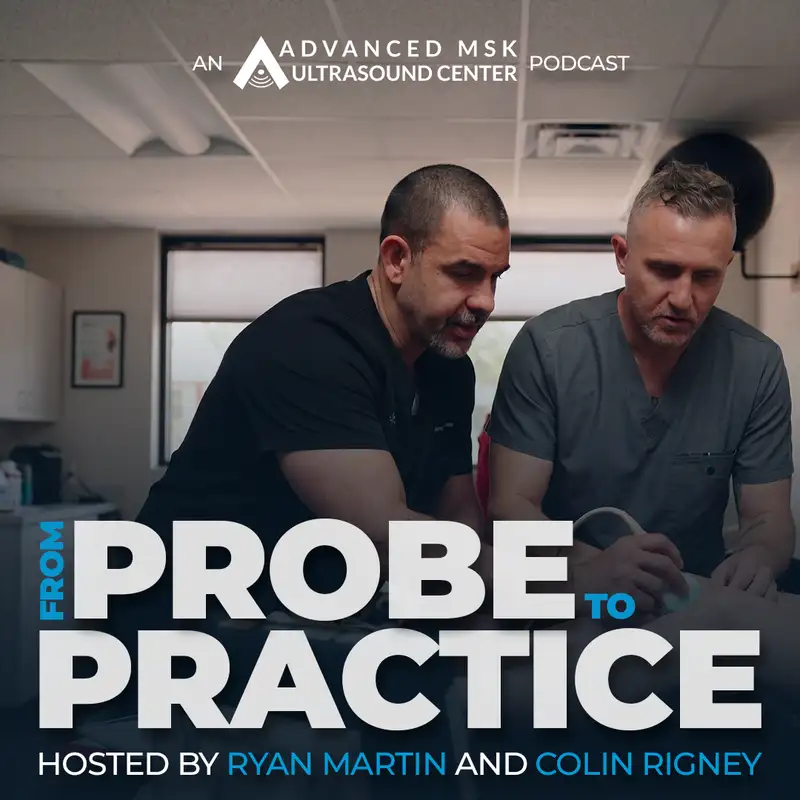
[0:00] This week on From Probe to Practice. Should you expect something that you don't expect today? Yes. Is that going to come in the form of like a robot coming in and doing a facet injection under ultrasound or fluoro guidance? An Advanced MSK Ultrasound Center podcast. From Probe to Practice. Hosted by Ryan Martin and Colin Rigney. Produced by Jason Kitza at NGG. needgreaters.com
[0:38] Ryan Martin: Welcome to Probe to Practice. This is episode number nine in the series that we've been putting together. We've been doing a lot of episodes about image acquisition, the physics of MSK ultrasound. We've had guest speakers on. Today, we're going to kind of go into a little bit of the future of healthcare, the future of MSK ultrasound, the future of MSK as a whole, and also what we have coming up in the series with AMSKU. I am Ryan Martin. I am a physical therapist and MSK ultrasound specialist. And we have Colin here. Hey Colin.
[1:14] Colin Rigney: What's up, Ryan? How you doing, man?
[1:17] Ryan Martin: Good, doing good. So what are you thinking about this topic for today? We're gonna be kind of going a little bit into predictions. You know, like what's coming up, not just for us as a company, happening, not just for MSK ultrasound, but health care. What what do we have coming up in the next 10 years? And this is kind of alluding to a nice little summit that might be coming up. So tell me a little bit about sure what's going on. Sure.
[1:44] Colin Rigney: Well, I mean, we were talking briefly about the robotic assisted blood draws right before we came on. So, I mean, you can you can follow the direction I want to take. this is how close how close are we to robotic assisted AI assisted needle guidance and like point of care imaging where patients don't have to leave the building what do you think
[2:09] Ryan Martin: Oh my god yeah so that that topic's been pretty hot on social media um especially with the phlebotomy the the robot existed and the numberings the numbers were pretty staggering on how accurate they were and when to call off a needle placement. I thought that was pretty interesting. So before we get into AI and robotic-assisted, I think we should just kind of foreshadow a little bit of some of the things that we want to talk about, like AI-assisted diagnosis from image to documentation. What's going to replace injections in the next 10 years? Like, what are we using now? What are we going to use in 10 years? What is the future of point of care? you know when they whether it's from ultrasound acquisition or any imaging acquisition and then what does an independent musculoskeletal clinic look like in 10 years so yeah let's go back to to point number one AI assisted stuff everybody's talking about AI AI is going to take my job you know robots are going to take everything and I think there's something to be said like yeah there's going to be certain jobs that you know robot assisted or AI assisted is going to do better you know from an algorithm perspective but um how does that relate to MSK ultrasound or how does that how does AI assisted diagnosis because we know it's already available right I mean do you remember working hours upon hours doing image acquisition to train AI yeah so I mean we've we've seen it from the inside and do I feel that there's a place for it Well, yeah, I think so. And I don't think it's going to take my job. I mean, I think it's going to augment and maybe assist in what we do and probably make our diagnostics maybe a little cleaner. And I think you've said this before, is you still need somebody on the back end of it, you know, reviewing it to make sure that even the margin of error that AI might have is we still need somebody to kind of clarify what's going on. so what do you think
[4:13] Colin Rigney: I think in general there's well first of all I I do think there's a bit of a psyop going on with AI I I do um in terms of there's people who are doomers about it and like there's there there's always something that you have to be aware of when it comes to a message with respect to like this this technology and I think it's going to significantly augment like what we're already doing and make the smarter people who are doing things really well to a high standard with systems in place like it's going to make you better it's gonna it's just enhance and streamline what you're already doing and for the people who are yeah I I guess it could replace a certain number of people, but where, where are you in terms of how you want to use it? That's really, it's going to make smart people smarter. I'm not going to say dumb, but people who aren't optimally like using it, like it's, it's going to, it's going to expose those types of people. So with respect to diagnostics, I, I, I'm an optimist in the the sense that I think that it can only it can only enhance and help what the current mission is with point of care imaging um right yeah I mean kick our robots gonna get ready to like replace um a sonographer I don't think we're quite there yet there's there's not enough it's not there yet right but we're talking could it be years could it be right years yeah absolutely I know. I think the trajectory is certainly possible for that.
[5:58] Ryan Martin: Right. And AI is just, it's getting better at a lot of things, you know. Now, can you go on social media and kind of detect people's BS on who's using Claude, GPT, whatever? Yeah. And I think if we look at ultrasound or at least image acquisition, we can't just rely heavily or we're a hundred percent on it. And that's why, you know, even when I use AI for idea generation, I still try and write all of my own content, you know? So, I mean, I think if we talk about ultrasound or image acquisition, we might use it. Like say, for example, Clarius is using that color coded image acquisition to kind of show where you're at and whether it's within normal ranges. I think that's, I mean, it might even be a good learning tool, but at this point in time, I wouldn't rely solely on that. So, and, and in 10 years, what is that going to look like? Man. I mean, if it's as good as it is now, I think it's only going to be better in 10 years, but I still think you're going to need somebody on the backend to, because here's another question is who takes liability for that? Right.
[7:05] Colin Rigney: It's going to be human or at least I think. Yeah. Who really knows? Do we really know? Yeah.
[7:12] Ryan Martin: Is it going to be a clinician or is it going to be a developer of the AI? right so
[7:16] Colin Rigney: No for sure yeah and I I think in 10 years in general man like just across the board I think we're going to see more advancements in human uh production of technology than there has been for the past 200 years like by far just in the next 10 so it's really hard to predict what the next 10 years is going to be like other than just to just to expect the unexpected or Or what you don't think is possible now that could be. There's just, we don't know what we don't know.
[7:45] Ryan Martin: We don't. And at the rate of advancement now, it's kind of scary. Like how awesome or how not so awesome it's going to be in 10 years, right? Yep. And so we're going to be discussing a lot of that stuff at the Global Summit in December. We're going to have over 30 speakers. And each one of them is going to give a nice prediction of what they feel is going to happen in the next 10 years. years. So I'm looking forward to that. But that brings me to the next one. I mean, we could talk about AI for the next hour. And, you know, there's a lot of, you know, you could go down so many rabbit holes with that. But let's talk about something a little bit more pertinent to us is what in the next 10 years do you think is going to replace the injections of today within 10 years, right? So I mean, let's kind of go into like, what are we seeing now versus what What do you think we're going to see more of?
[8:41] Colin Rigney: Same thing. I don't know. I, I, I, it, you can't plant your flag right now because, um, should you expect something that, that you don't expect today? Yes. Does that, is that going to come in the form of like an independent, like a robot coming in and doing a, a facet injection under ultrasound or fluoro guidance in 10 years? I'm not going to write it off, but I'll just leave it open to the possibility.
[9:14] Ryan Martin: Well, I mean, if a robot is drawing blood right now. Yeah. And it's at a pretty high success rate. And this is like early, early advancements. Yeah. It makes you wonder in 10 years, will we be able to have surgical like AI surgical or even, you know, injection based type stuff, but even beyond the AI type stuff like and again, I'm not going to go into the weeds of what's actually being used. But do you think like the RegenMed is going to expand a lot more in the next 10 years versus kind of what we're using or what you see being used by our clinicians and our physicians in clinic now?
[10:00] Colin Rigney: I mean, it that's it's really broad. In the next 10 years, yes, I think it's going to be more it's continuing to come into the mainstream conversation. And there's an increasing amount of the population who are looking for alternatives outside of what's in the mainstream offering with respect to insurance-based care and that sort of thing. So, yes, it's going to continue to advance and it's going to be market-driven. And meaning as the information becomes more readily available and people have access to more free information now more than ever, it's going to continue to be increasing in demand. Just from an economics perspective, the market is going to demand it. The market is going to dictate the advancement of it. That's my opinion. It's super broad. Okay. But that's, everything is market driven with respect to these concepts and how that's going to happen mechanically. I'm not going to pretend to know. I really don't. I do think that the human innovators today are going to drive the model of the advancement of it and what that's going to look like. I don't know. Um, I, I am bullish on advancement and the human, um, input of what that looks like today. And, and again, I'm an optimist in the sense that I do think that it's going to lead us in a good direction, uh, in terms of having more options for people that it makes sense for, and they want it and they demand an alternative to what is traditionally offered for a lot of common conditions.
[12:00] Ryan Martin: Okay. I mean, that's a very diplomatic response. I'll use it. I like it. Well, so moving on then. So the future of point of care, right? So the future of bedside treatment, we kind of talked a little bit about it with the AI-assisted diagnosis. diagnosis. But the future of point of care, what does that mean to the patients? And what does that mean to the practitioners? I mean, can we do virtual assisted diagnostics? Do they have to leave their house anymore? To you, what does that look like moving forward five years, 10 years from now? What does point of care look like for patients?
[12:47] Colin Rigney: Well, whether it means they have to leave their house or not um if they go to one appointment they leave with all the answers right at a bare minimum meaning um a I what what I am extremely bullish on and what I think is already happening is AI can can take a history better and more consistent than any human can if you train it the right way right and with that information what happens at the point of care if you have enough robotic-assisted diagnostics at that point of care. In theory, the patient can leave in, you know, 30 to 60 minutes with more answers for what they came in for than what's happened in the previous 10 years. Right. You know, whether that comes, you know, again, a broad answer, but I do think that that's the way it's trending. Now, can they leave there with, you know, the question of, can they leave their house? Do they have to leave their house for it? What do you think about that?
[13:54] Ryan Martin: So I envision like this crazy Futurama kind of thing where you set an appointment, you know, with some, you know, it could be automated system. You kind of give them your information on what your issues are and it comes up with an algorithm. And then lo and behold, at your doorstep, you know, some drone drops off a package that has, you know, this little AI assisted, you know device that gets uh ultrasound done with all the instructions and it tells you how to do it and it guides you through everything and on the back end you might have you know another uh AI agent that kind of reads the diagnostics and then it interprets it and maybe there's a human in the background that says yay or nay to everything but I had like this like really crazy you know like Like, we only saw it in the movies before, right? You know, hoverboards and Blade Runner and all that kind of stuff, you know, flying cars. So I think in 10 years, is there a way that we can deliver diagnostics without patients leaving their house? In 10 years, yeah, you know, like, now, how efficient is it going to be? And does, the real question is, is... At scale? Yeah, well, at scale, I think it'll be even easier. But here's the real question is, is that what people want? What is the next generation of people or even our generation as we age? Are we going to want that? Or do we want that human interaction? There's something to be said about that. Not everybody has a great bedside manner, but there's something to be said about having that interaction. action.
[15:31] Colin Rigney: So, well, and, and that, that was back to my original points about the market, the market's going to, the market's going to drive it. And, and again, yeah, it's broad. It's, I don't, I don't think it's diplomatic, but I think it's the market. I just don't know what, I don't know what it's going to be. Is the market going to demand an Amazon or is the market going to demand the in person, the human touch, right? And so you have to, I think it's going to be both and there's going to be some overlap right for the common cold for the common things right that you don't want to leave your house for that stuff and really right now a lot of us aren't like already it's all it's already happening seriously and you know you can get free you can get pharmaceutical you know things delivered to your doorstep having a have a telehealth appointment like those things are already happening it's just the transitions at the rate that is going to happen in the next 10 years is going to be so rapid that most of us probably aren't going to be conscious enough to pick up on it and then it's going to be 2036 and like holy shit you know we've come this far look at this or look at this stuff and you've just been conditioned to it day by day by day by day by day by day by day until it's your norm you're standing there and you're like wow look at this now you know what I mean so uh yes I I do think in 10 years there's still going to be a human element to this. There really is. Is it going to be at the scale we know it today? Probably. They're definitely not. Definitely not. Uh, I know that to what degree I'm not going to, I don't know, but could it be drastic? Yes, I think so.
[17:11] Ryan Martin: Okay. So your final take, are people going to leave their house in 10 years for healthcare? Yay or nay?
[17:20] Colin Rigney: Yes. Okay. But not like we know it today. day.
[17:23] Ryan Martin: Of course not. Okay. So moving on, um, on my show notes here, I really want to kind of go over like we work in MSK clinics when you can call them what you want, uh, sports medicine with family practice, um, you know, regen med, whatever you want to call it. So MSK, we'll just generalize it to musculoskeletal clinics. And again, we're doing predictions here. That's, our theme. In the next 10 years, what does an independent MSK clinic look like? So what is it going to, what do you see? Is there going to be any significant changes? I mean, taking all the topics that we've already talked about, what do you see for these types of clinics that we're already in and involved with? What do you see in the next 10 years?
[18:10] Colin Rigney: Well, where do you want to to start. Maybe pick one thing.
[18:14] Ryan Martin: Okay. So let's break it down a little bit then. An MSK clinic, so orthobiologic regen med type of sports medicine clinic. What do you think the flow is going to look like? Do you think it's going to be the same type of patient interaction? Do you think it's going to be the same treatment model? Do you think that they're just not going going to exist and we're going to have something else that replaces them. So just real generally, what do you think some of the biggest changes in our industry in those clinics will be?
[18:53] Colin Rigney: I think what you'll see is like the people who are doing it really elite today, already doing patients coming in, getting a diagnosis same day and treatment same day. you're going to see that just happen at a more rapid pace. More people are going to be able to do that and what you're going to see is what used to take an hour and a half two hours. Marc Pietropaoli is a great example of his Clarity Day when patients come in and get their MRI, their ultrasound, their x-ray, physical exam and a treatment if you need it same day right? But I think what's going to happen is instead of that being those times, whatever patient expectation times, um, are coming in like times to commit for that day, it's just going to get, it's just going to get more efficient and the potential for, um, for this to happen more scale, not potential, but for this to happen at scale, it's just going to continue again, it's going to be a slow creep. And then as the way way compound, the way compounding things work is it in 10 years, you're going to see more of this being like, this will be the standard. Like, and then what that standard is, it's going to be like Ruth is so ruthlessly efficient that it's hard for us to even consider it. Now it's going to sound really radical.
[20:27] Ryan Martin: Yeah. Well, okay. So I'm going to, I'm going to be devil's advocate here a little bit. Let me go get my big wooden spoon and cauldron and stir it up a little bit. And we're seeing this. We're seeing big corporations gobble up the mom and pop sports med type of clinics. Okay, I'm just going to ask real quick. Do you see the independent practices thriving and becoming more ubiquitous in the system? Or do you feel that corporate corporate healthcare is going to take over all these small mom and pop shops?
[21:08] Colin Rigney: Well, sorry, I had to throw two things can be true. Corporate is going to take over massively. It already is. That's not a, that's not, that's not earth shattering. It's going to be market driven. It goes back to the market. And what you're seeing with that is that's driving more of the market who wants the human touch. They want the concierge. They want answers. They don't want want to go they don't want to get treated like a you know part of a herd they're going to seek out the people who are personable have character and are able to like actually interact like a real human that's what a certain market demand is going to want with respect to their health care you know what I mean and there's and and and is there a large part of the population that corporate healthcare makes sense for? Yes. Because again, market demand is what part of the market society loves eating fast food, right? It drives the demand of those places. And healthcare is really not a whole lot different.
[22:13] Ryan Martin: Understood. Well, I mean, we could make as many predictions as we want. And that's the beauty of predictions is there nothing more than predictions, right? Right. You know, we're not stating a fact that this is what's going to happen. And that's why I like the summit theme this year is, you know, the next decade is in your hands. I think that's like beautifully stated. And I think getting perspective of these 30 speakers and and all these other people that are coming out and doing predictions, I think it's going to be interesting, interesting to see how everybody varies on their prediction, how many similarities we have in their predictions. and you know and then we're going to lock them in a vault and open them in 10 years and see who was
[22:53] Colin Rigney: Right yeah I mean this is this is this is part of the fun right you know it's getting a collective together and allowing first of all allowing um just it to be shared and then the way that you know the way that message goes out like people can interpret for themselves you know yeah and And it's just, it's really just fun, you know, because really it's, we're, we're on the cusp of something that's, that's, uh, evolving and at a rate that, you know, if you look back, what's in 2016, right. Compare what we're doing now to 2016. Yeah. You know what I mean? Like it just take a look back and then look to where you are now. And then it allows, it just gives you perspective on like, do you, do we really know? Okay. Is it cool to imagine? Like things don't happen without imagination. And so that's the fun of doing this. And so, you know, look forward to this next couple of months and hopefully bringing some good, you know, some of the speakers on to give some teasers as, you know, as to, you know, what, where their mind is at with some of these questions. And again, you know, leave it open. This is an open forum. It's open collective.
[24:11] Ryan Martin: Absolutely. Well, I mean, speaking of the future, let's talk a little bit about the future of the podcast. Do you happen to have anybody lined up that might be on this show?
[24:23] Colin Rigney: Well, we've got a fair number of them. We know Matthew Gillogly is going to come on here in the next couple of weeks. Marc Pietropaoli, Ariana DeMers. And, you know, we can go, there's quite the list we are developing, right? So that's just a little tease of names.
[24:44] Ryan Martin: Well, if anybody out there loves this banter and loves this information, I would highly, highly recommend going to summit.AMSKU.com. Now, what that is, is summit.AMSKU.com. And you can see the list of speakers that we're going to have in December. And again, it's growing. We're still going to have a couple more that are adding on to this. So if you enjoy these predictions, if you enjoy listening to MSK Ultrasound, Orthobiologics, you know, anything in the region, med, and we're going to have business perspectives on there, I highly recommend, and we're going to put this in the show notes, I highly recommend, please check that out.
[25:21] Colin Rigney: Yep. Check it out, guys. It's on the banner of your screen. Yeah.
[25:27] Ryan Martin: Where is that banner? Read that and go there.
[25:29] Colin Rigney: You can look to last year, and there's a good handful coming back from last year, and a lot of new people coming on, and we counted, what, Ryan, across how many continents? Five continents, right?
[25:43] Ryan Martin: Six continents. Six continents.
[25:45] Colin Rigney: We're missing Antarctica.
[25:46] Ryan Martin: Antarctica, right. So if anybody out there knows a practitioner that has a great lecture and a prediction for the future out in Antarctica, reach out to me. I would love to actually state that AMSKU has covered all the seven continents with speakers and information. Yeah.
[26:03] Colin Rigney: So, I mean, in line with just the vision for what health care can be, this isn't just a United States thing. this is a global thing and and to get a perspective what other where the people in the globe are doing and what they see their perspective on MSK healthcare and advancements in their region right that you you can't ask for any better setting yeah what makes this thing what it is are the innovators who are driving it and some not some all of the speakers are going to have have something that you're going to take something away from, even if it's just one thing that's going to impact the way you think, the way you practice, the way you develop as these next 10 years evolve.
[26:52] Ryan Martin: The show notes are going to have, you know, our information to reach out to us. If you have questions, comments, concerns, letters to the editors, quarrels, qualms, anything of that nature, reach out. With that being said, Colin Rigney, thank you so much for being a part of this journey with the AMSKU team. I love what we're doing. I'm loving to see where we're going to go in the next 10 years. Signing out, Colin.
[27:14] Colin Rigney: All right, guys, we'll see you soon.
[27:21] Here's what some of the speakers from last year's annual Global Summit had to say. We can definitely end the need for knee replacements. I feel as though this Global Summit is literally the spark that's going to help us end the need for knee replacement surgery. I truly feel that way. I didn't have this 34 years ago. Colin and Ryan didn't have this. None of the people. Dr. Buford didn't have this. Dr. Centeno. We all kind of learned on our own. But to have something like this summit, you're very fortunate. And so don't waste it. Don't blow the opportunity. I love these approaches. And especially now with this day, with this summit, Colin, I have to tell you guys, it's an awesome work because this mechanism, doing with the external things, non-invasive, with invasive stuff, with ultrasound, with lifestyle, we had everything in one summit. I haven't had it before. I haven't seen this before. And I want to thank Ryan and Colin for putting together such an extraordinary summit. The speaker panel is tremendous, and I'm honored and grateful to be a part of this. Thank you so much for putting this together, Ryan. I think this was really, really helpful and enlightening to all of us speakers as well. So thank you. An Advanced MSK Ultrasound Center podcast from probe to practice. Hosted by Ryan Martin and Colin Rigney. Produced by Jason Kitza at NGG needgreaters.com If you want to watch the playback from last year's annual Global Summit or if you'd like to register for this year's annual Global Summit visit summit.AMSKU.com