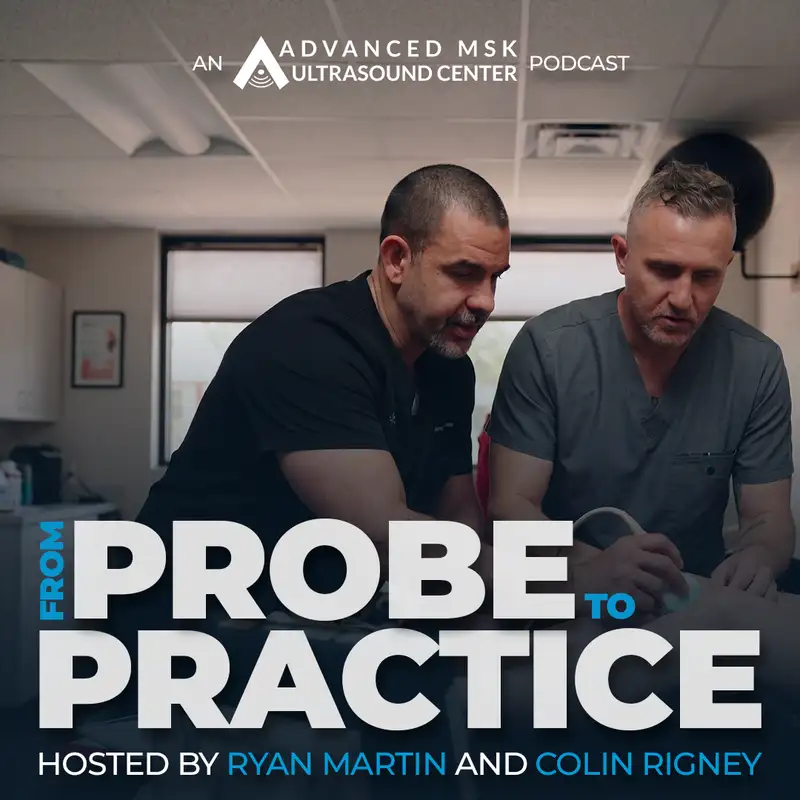
So whether you know it or not, you have a gap in your practice. MSK ultrasound is going to be the next standard of care. You can't diagnose what you can't see. An advanced MSK ultrasound center podcast From Probe to Practice. Hosted by Ryan Martin and Colin Rigney.
Produced by Jason Kitza at NGG. needgreaters.com. I'm Colin Rigney. I am the CEO and the co-founder of the Advanced Musculoskeletal Ultrasound Center. So, I am Ryan Martin.
I am one of the founders of AMSKU, and I am one of the directors of all the education and content. I'm an educator. I'm a physical therapist. If you don't know me, my background is in physical therapy. I love doing social media.
I love public speaking, and I love teaching MSK ultrasound. From Probe to Practice is a practical platform where Ryan and I are going to discuss medical things, but not in the format that most doctors and clinicians are used to operating in. To me, it was a way to get our voices out there and get awareness of MSK ultrasound education and beyond. We want to take the stuffiness out of it and create something that's real dialogue, yet educational. So we do teach MSK ultrasound, but we also teach, you know, integration into practice, business.
Layered in with some comedy and really just provide something for physicians, clinicians who are looking to take the next step into their practice, which is incorporating musculoskeletal ultrasound. So I think probe to practice was a great vehicle to kind of push those ideas forward. The show exists to fill in the gaps that everybody has. So whether you know it or not, you have a gap in your practice. If you're thinking about incorporating ultrasound, if you just incorporated or you've already been doing it, I guarantee you there's gaps in what you're doing and it can be improved.
That's why we're doing this. That's why it exists. this? So when developing this podcast, we wanted a specific category of people that we're really trying to reach out to. This is going to be the sports med, orthopedic background, sports science background, people that are looking to incorporate MSK ultrasound, or they've done a little bit of MSK ultrasound.
And throughout their week, they may get a few patients that require additional imaging and they just can't do it. So for those that are referring unnecessarily to imaging centers or specialists and MSK ultrasound could fill that gap. The moment of clarity when a clinician thinks to themselves, I need more is when they're sitting in front of a patient and they just don't have the answer. I think the moment in practice that makes someone reach for the show is, you know, the PRP injection that didn't work or missed the mark. Did it miss the mark because we missed the diagnosis?
Or did we simply miss the mark because our technical skills weren't there? They just don't have enough information to make a clear diagnosis. And they think to themselves, what do I need to do to get to that next level of diagnostics? And that's when they usually reach out to us. MSK ultrasound is the conversation in regenerative medicine right now because MSK ultrasound is the gateway to regenerative medicine.
When you talk about injecting specific orthobiologics, you have to be point on. You have to be dead center. You have to know where exactly you are. You can't diagnose what you can't see. Previously in practice, if If practitioners were using steroids, you know, close counts, you can get it in the area.
But now you have to be laser focused and it has to get delivered where it's supposed to. To be able to do ultrasound at the point of care and deliver an intervention on the same day, no other imaging tool can do that but MSK ultrasound. This is a conversation about how to make it work in your favor. From Probe to Practice is not a 45-minute monologue or lecture that you have to sit through and try and stay awake for. What this is instead is kind of a high-energy dialogue to bring awareness to what we're doing.
And yes, you're going to learn on the way, but it's not going to feel like sitting through a lecture. You're listening to two guys who just are sharing a passion and a lifetime and a career of what they've experienced, and there's much to share in that experience and that passion. One of the beauties of this podcast is we bring a little bit of personality and flavor to it. It's not just a boring, didactic, run-of-the-mill, hey, let's just talk about ultrasound. Colin and I have a lot of banter.
We've been together as business partners for many years, and so we have a lot of dirt on each other. So we get a lot of fun stories and banter, and there's a lot of back and forth. And so this is not your average podcast. This is going to have some live humor, and it's going to be fun. This is going to be from business to personal to technical skills to case studies to jokes.
So the kind of episodes that you can expect here, everything from scanning techniques, how you do the shoulder, how do we look at the AC joint, how do we look at the poster capsule, what's the latest research on injections for hydrodilatations? We're going to be looking at integration techniques. Yes, MSK ultrasound is going to be the key centerpiece, how it's used in the point of care. Really, no matter what setting you're in, how it can be used, right? You could be watching us and learn, hey, what's the business?
What is the return on investment? How am I going to make money on this? What are the best machines? We're going to talk about what are the handhelds versus laptops versus cart machines and why one would fit better into your practice. We're going to help people get unstuck with their style of practice.
And we're going to give real-life case studies on shared experiences on MSK ultrasound, difficult cases, difficult diagnostics, and interventions. interventions. We did a special guest appearance with Dr. Greg Zakas, a good friend of ours. And I'm not going to give any spoilers, but we're going to go into a lot of the history of how we knew each other and how he developed his skill set with AMSKU over the years and what he's doing with it now.
Little hint, check him on Instagram. Not just through our eyes, but through a lot of the friends and guests that we have on the show. People like Greg Zakas, people like Don Buford, people like Ariana DeMers and Roddy McGee um Matthew Gillogly there's there's a range of people who come from various walks of life that we've interacted with over the years what they'll walk away with is an understanding of a scanning technique or how to implement and integrate msk will just sound in their current practice so they can take something that they learn from a a podcast on Friday, kind of mull it over, and then implement it on Monday. If a clinician just listens to one episode, they're going to walk away with something they can apply immediately, whether it's a technical skill, a philosophical perspective, or just a mental gap that maybe they didn't know they had. So when clinicians are sitting with us and the burning questions that they have for Colin into myself are, how much time does this take?
Can I integrate this into my practice? And will it make a difference? And something that we're going to go over in these episodes for From Probe to Practice is, yes, you should use this. Yes, it can be integrated into your practice. And yes, it can be financially beneficial if you know how to utilize it.
Something I see week after week in the offices, in the places I work, in the doctors we train, is we can make the complex things simple. That's what this is about. It's our hope that the platform itself provides a level of education and also entertainment that is a unique blend in the space that can be, at times, let's be frank, really dry. and provide an educational escape. You know, six months from now, what I would like for this show to become for people that are tuned in from the beginning is building that community.
For those who are in the field or adjacent to the field, or maybe you work with somebody who's in the field, you know, and this will reach those people as well. Wow. Is having the ability to reach out to us and have us answer your questions right here in six months, what I'm hoping for is a nice collective group of like-minded people who are all trying to grow and learn at the same rate. We'd like for this to be a home for people who are in the space of regenerative medicine, musculoskeletal medicine. And if you're not directly in the practice, you are married to or adjacently have a relationship with somebody in the field.
you don't have to. All we ask is that you give us a chance and listen to an episode or two. We're here to educate and provide life experiences from our perspectives and the people we work with. So if you're a clinician, you're on the fence for hitting that follow button right there. All I can tell you is MSK ultrasound is going to be the next standard of care.
Every other clinician is going to get on the bandwagon and it would not be a good thing to be behind the eight ball on this one. And it's our hope that these stories can go out and reach many doctors that simply, we don't have the bandwidth to do on our own. If you're a clinician, who wants to see what you've been missing, this show is for you. From probe to practice, an advanced musculoskeletal ultrasound center podcast. New episodes weekly, links in the show notes.
I'm Ryan Martin. I'm here with Colin Rigney. Let's go. I'm Colin Rigney. me let's get to work ultrasound isn't just imaging it's it's it's real-time interrogation right and and if you don't understand artifacts and echo texture the machine will lie to you all day long because in the beginning stage it's really going to fool you you know i just think everything you know everything was tendinosis every something was gone um you know i never knew what i was i never knew an incidental finding versus a false positive or in some cases a false negative well It's like the only imaging modality that you can create your own pathology with a flick of a wrist.
If you're looking to do it the right way, you can't take shortcuts, right? And there's no shortcuts with ultrasound. You know, certainly with learning how to use it diagnostically, the reps have to be intentional. You have to know how to use it if you want to be accurate. Progress over perfection.
People say, I don't have time. You have time. Everybody has time. It's just, how do you prioritize it? Don't forget what got you here.
Like, this is just a tool. It's not replacing, it's not replacing like your clinical, your clinical skills and background. I know the grass is greener over there, but I just don't want to make the effort to climb over the fence. And diagnostic musculoskeletal ultrasound really is the next generation. And if you are not embracing it, you are going to be left behind, period.
And it's an extension of your physical exam. An Advanced MSK Ultrasound Center Podcast. From Probe to Practice, hosted by Ryan Martin and Colin Rigney, produced by Jason Kitza at NGG, needgreaters.com. If you have any questions about today's episode or are curious to know more about AMSKU, visit amsku.com or check the links in the show notes.