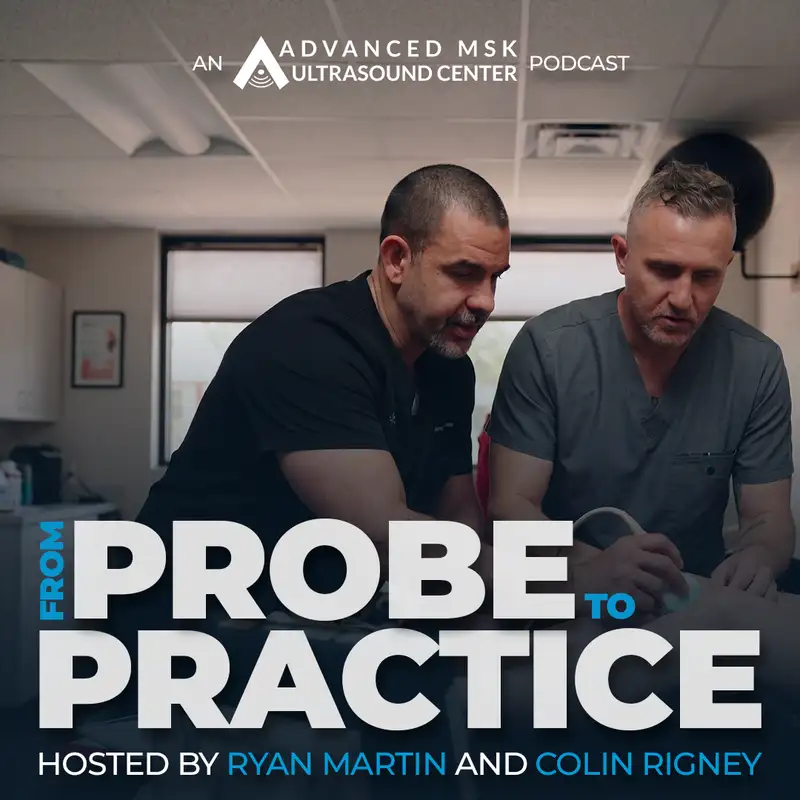
[0:00] This week on From Probe to Practice. And judge it the wrong way. They look at it as like this massive mountain they have to climb. And it's just like, it's just psychologically not worth considering because I don't want to go back to school, right? And complain to me like, oh, it's so user dependent. Yeah, it is user dependent. And guess what? There's training for that. An Advanced MSK Ultrasound Center podcast. From Probe to Practice.
[0:38] Ryan Martin: Hey everybody, Ryan Martin here. This is Probe to Practice. I'm here with Colin Rigney. How you doing? I'm doing wonderful. How's it going, man? It's good. These podcasts are turning into something very interesting, very fun, and a lot of good information. and we're going to be talking about objections to using MSK ultrasound in practice. And I think one of the big objections that we have or that keeps coming up is user dependence. And when I say user dependence, an MRI, a tech takes pictures and then somebody reads it later or x-rays or CTs. Ultrasound is hands-on, user dependent to get those ultrasound scans. So a lot of people will poo-poo on MSK ultrasound because it relies heavily on user dependence and I think that's something I want to talk to you about is is that true and and how do we overcome that and how do we talk to people that have that objection Colin it's I
[1:45] Colin Rigney: I like I like how you said it with the MRI because in the kind of standard algorithm community like MRI is the gold standard right we hear that a lot and we have to remember that you know um there's operator dependency with reading mris right there's pattern recognition I know with AI coming right it's there's some there's some um changes happening they're probably going to be helpful but point nonetheless is you shooting x-rays okay it's position dependent um mris is reader dependent and so there's there's dependency in all of these things and it comes down to pattern recognition okay in ultrasound and I'll kick it back to you but ultrasound when you're you work with humans okay that's that's one little that's one variable here okay but in a lot of ways training just like our surgeon trains a system right in their shoulder scopes ultrasound is really no different right Ryan so like if you're training somebody to do a shoulder scope it's check check check check check system based okay ultrasound is same thing if you're gonna scan a shoulder it's system based we're just shining a flashlight underneath the skin and going through our checkpoints right
[2:55] Ryan Martin: No absolutely and and when you say systems even MRI techs or ct scan or rad text they have to know systems they have to know how to do you know an appropriate MRI like what's the what's the seating or laying down position or what what is it that I'm doing and they have to go through checklists so no matter what modality you're talking about you're always going to have to have a checklist of things you need to do right get it done right I think one of the problems is people say that ultrasound is a handheld or a manipulative technique meaning that you have to actually do something and drive something and you have to have a hand-eye coordination to do that um but there's a system to that too right so there's a system to training all of this I think that's what it really comes down to is no matter what modality of imaging you're looking at you have to get training right Right. Yeah. You can't become an MRI tech or a rad tech or you can't do you can't do shoulder scopes, you know, all based on online training. You have to have legitimate, systematized, yeah, legitimate, systematized training to do what to do what you have to do. So when people sit there and complain to me like, oh, it's so user dependent. Yeah, it is user dependent. And guess what? There's training for that. so I to me I I don't find that as like a good argument on why somebody wouldn't want to bring MSK ultrasound into their practice is user dependence I I find that there's so many holes in that and there's so many ways to avoid that pitfall um and again having resources such as AMSKU having oh that's funny we have scanning guides we have things that show you from point a A, to point B on how do you do this scan, right? Right. Oh, is there video tutorials that we show how to do it from start to finish and where to put your hand and how to do that? Absolutely. What's missing? The hands-on. Oh, do we have a program where you get hands-on training? Yes. So is it feasible to overcome user dependency in MSK Ultrasound? A hundred percent. A hundred percent. Sorry. I don't mean to get fired up, but I have that question all the time. you know I I get this I get this question all the time and say well you know uh it's it there's so many errors in ultrasound because of user dependence yeah well guess what there's errors in ultra there's errors in MRI ct scans there's errors in surgery right yeah so the best thing that I can tell these people is get trained correctly and that shouldn't be an issue so anyway that's no I I hate to be on a soapbox but this is one of those things that really just kind kind of gets to me is when people complain about like how how how many variables based on you know just user dependency ultrasound has it's just like anything yeah heck you're not going to be a lawyer without knowing systems you're not going to be a mechanic without being without knowing systems you know ultrasound's no different you systematize it you understand that algorithm and you go by it now do you have to go off the cuff sometimes and do something that's not necessarily on that well Well, yeah, but that's where mentorship and repetition comes in. You see enough really weird things, you start to understand like, okay, I can go off the beaten path here, but I have to follow my system first. So anyway, that's my 10 cents on the whole situation. Do you have any thoughts on this?
[6:34] Colin Rigney: Of course, but you can stay on the soapbox. You know, I had a coach and I had a coach in college. We only ran a handful of plays in basketball. Like literally, we only had three scheduled plays that we had to memorize. Everything else was just plays broken off of those three plays. And so plays are made to be broken was essentially the take home. and once you have once you have knowledge base of your playbook your protocols your foundations then you can start to break plays right but that can only come with a number of reps feedback loops and um you know time and repetition on it so yeah so it's not so much it's not so much operator dependent I I'll say it's not even so much operator dependent but really a system dependent training would you agree
[7:23] Ryan Martin: Oh 100 but here's the thing and you nailed it is if you you don't know the system first how do you know to go off the script right right otherwise everything's off the script everything's ad-libbed right and so right no you're no you're you're absolutely right and so um and so what do we what do we what do you say to I don't know clinician a that that you're in a discovery call or a call with and they say well it's just too user dependent what's what's your go-to to talk them through this well I I'll come back to them
[7:59] Colin Rigney: With the skill that they know best and I'll ask them how they learned it so you know I I spoke to a guy a couple weeks ago about you know he is an emergency room physician that is stretching his practice he's opening into MSK but he'd been doing he got into like longevity and health and wellness and stellate ganglion blocks which is a very technical procedure he's an he's an er physician right so no traditional training in this and I asked him you know how many reps did it take you to get comfortable with that and he's like oh at least 50 and in your in your path from zero to 50 did you have uh a resource a backboard to help guide you in in certain cases certain instances he's like absolutely he said okay so what you went through there that's a that's kind of a metaphor for what we do with ultrasound MSK right I just get to know the person you know yeah um you know I spent between it's thursday today um between this thursday and last thursday I've worked with 15 orthopedic surgeons one occupational medicine doc and one naturopathic physician and I'll go go with ortho because that was largely who who who I was encountering um yeah I I just go to what is you know what got you to where you are right and when you went through residency and fellowship how was the process of learning that and I'll put one skill like a shoulder scope is easy because it's very very consistent with the exam that we do with ultrasound and and so you know before you choose to do anything in that shoulder while you're in there what do you do first it's like well we do our diagnostics okay great so that's what we're doing with ultrasound and you know tell them that it's it's very system dependent and within that system you know the road to mastery goes through incompetency and the faster you're willing to go through the incompetency stage with more reps and feedback guess what the faster you're going to learn right so you work with a guy last week who really just started with us in february and you know he was he was commenting about his practice this weekend and how he before working with us that he had not ever done an ultrasound diagnostic and ultrasound guided injection and within from february to june he's put in a massive amount of work that now he's so this week he has two PRPs and a bone marrow procedure for rotator cuff and knee arthritis that he's all doing ultrasound guided he was not doing that in in february right and so it just took you just kind of meet people where they're at with their background skill set how they got to where they are and help them understand that you know this system learning a system like this is no different than what you've already done you just have to switch your brain over a little bit yeah absolutely
[11:02] Ryan Martin: That's that's actually a really good good way to put it is how did you get through your life this far you're telling me that there was no systems that your your whole life is just like entropy and just random or did you have systems that kind of help you got to where you were I love I love how you phrased it so all right well so yeah
[11:22] Colin Rigney: Well no that's good so like tell me you know what outside of a truth outside of a fellowship model you know what what's the path and what does the path look like for for people who really want to learn MSK ultrasound and apply it to their practice outside of a residency or fellowship style
[11:44] Ryan Martin: I mean it's a lot of time by yourself a lot of time with online a lot of time with you know resources but you're just you're just taking something that could take less time you're just you're just spreading out way too far and you're not going to implement that skill set as quickly or as efficiently so the the path to learning without a fellowship is in my opinion I don't want to say futile but I I just don't see it as a solid learning mechanism in this type of modality especially when we're talking about user dependence you know coming coming around full circle is you don't, you don't take that lightly, right? Like you wouldn't want to go into this with a YouTube. And I always make the analogy to people is I can read a hundred books on how to ride a bicycle, but until I go and do it and have somebody there, like I didn't just pick it up and learn how to ride a bike on my own. I had a mentor. I had my father, right? Right. Like I have somebody there coaching me and showing me how to do it. And had I read a hundred books prior to that, that would not have changed. That would have helped me from a mental standpoint. But you have to have somebody there and you have to go do it. Right. It has to be hands on.
[13:05] Colin Rigney: Yeah. Yeah, totally. Absolutely. Yeah. So the you know, it's just I mean, it can be done if you're unique. I mean, if you just have an incredible work ethic and you have a network of people who can maybe point you in the right direction, but you're going to spend the same amount of time and financial capital on your own or more like trying to trying to like get to, you know, get to competency. Right. I mean, for example, I had a doc. He's one of our residents. And he summed it up like this is he wanted to do ultrasound. He had tried stuff online. He just couldn't get motivated enough independently. Now, again, motivation, inspiration, whatever. But he said since starting the, you know, residency style program, he feels like he has something there to kind of like push him and motivate him to continue learning. You know, whereas if you're doing it by yourself, there's going to be who's there in your core ability. Yeah. Yeah. Who's there with you? Right. So it's accountability, right? Yeah. Yeah, it's accountability. And yeah,
[14:15] Ryan Martin: You could falter with a mentor as well. But you're you're less likely because you're going to have somebody there that's like trying to encourage that learning versus, oh, am I going to look at YouTube tonight and watch that that ultrasound scan? Or, you know, I just feel that there's not enough motivation to do that.
[14:34] Colin Rigney: No, it takes a unique person, highly disciplined to do that stuff on your own. You know, there's something to be said for being having an accountability structure built into your learning.
[14:44] Ryan Martin: Right. Yeah, absolutely. And that's part of system. Systematizing, you know, right. Yep, exactly. So, well, this is one of those conversations that, you know, I always love these. I always, you know, because I like finding I don't like arguing per se, but I like it when somebody has, you know, a contradiction or they have like some sort of argument to bring up about what it is we do or what we believe in. I love having that debate or that discussion and I, and I get to do it every day on social media, to be honest. So I think, but I think it's good now to just kind of get it out in the open and discuss it on, uh, uh, you know, a forum, like a podcast here. So. Right.
[15:38] Colin Rigney: Right. And, and, and, you know, you and I have, obviously we're, we're convicted here and, and at the end of the day, you want to, you want to understand where people are coming from. The the only way to do that is to ask questions and sometimes those questions come in the form of you know perceived objections right and so yeah when it comes to like in a lot of times it's mental and psychological honestly I think people look at something um unnecessarily in in in judge it the wrong way they look at it as like this this massive mountain they have to climb and it's just like it's just psychologically not worth considering because I don't want to go back to to school right yeah um that I get a lot of that did I lose you no I'm here oh okay I just yeah yeah I just I was just kicking the thought around so yeah so I think we could probably we could probably wrap this one up I think that was a hard hitter and and and you know really the point of these is you know for anyone who's listening is to we want to we want to promote best practices is we want to we want to first of all impact as many people as possible with with this skill in and help them understand that you know with with the skill with the tool in your hands there's a lot there's a lot you can offer your community a lot you can offer your colleagues and the more people who go down the road of doing this ultra MSK ultrasound at the point of care and practicing at the highest standard with it and we always strive to do that it's it's going to have such such a big impact on, on the medical community, but also just the, you know, the, the community at large, right. Society. And that's what it's all about. No, a hundred percent, a hundred percent.
[17:34] Ryan Martin: Great topic as always, Colin, I'm looking forward to, you know, getting pushed out there and having people, you know, write us and contact us about what their thoughts are about, you know, user dependence. I think we're going to do a couple more episodes to where we take what people find find, you know, is that, you know, what is it that they find negative about ultrasound? And we should just discuss those things.
[18:01] Colin Rigney: Yeah. Yeah. We should, we should, and we should maybe do a live one and have people ask questions live at some point.
[18:07] Ryan Martin: I love that idea. I love that idea. Well, it looks like I'm at my destination. So thank you, Colin, so much for, for bringing these topics up. up. I love it.
[18:19] Colin Rigney: Yep. You got it, brother. All right, everyone. Take care.
[18:23] Here's what some of the speakers from last year's annual Global Summit had to say. We can definitely end the need for knee replacements. I feel as though this Global Summit is literally the spark that's going to help us end the need for knee replacement surgery. I truly feel that way. I didn't have this 34 years ago. Colin and Ryan didn't have this. None of the people, Dr. Buford didn't have this. Dr. Centeno. We all kind of learned on our own. But to have something like this summit, it's very you're very fortunate and so don't waste it don't blow the opportunity I love these approaches and especially now with when this with this day with this summit calling I have to tell you guys it's an awesome work because and this mechanism I'm doing with with the external things non-invasive with invasive stuff with ultrasound with lifestyle we had everything in one in one summit I haven't I haven't had it before I haven't seen this before and I want to thank uh Ryan and Colin for putting together such an extraordinary summit. The speaker panel is tremendous and I'm honored and grateful to be a part of this. Thank you so much for putting this together, Ryan. I think this was really, really helpful and enlightening to all of us speakers as well. So thank you. An Advanced MSK Ultrasound Center Podcast. From Probe to Practice. Hosted by Ryan Ryan Martin and Colin Rigney, produced by Jason Kitza at NGG, needgreaters.com. If you want to watch the playback from last year's annual global summit, or if you'd like to register for this year's annual global summit, visit summit.AMSKU.com.